


Are you an "early adopter" of new products, or do you watch and wait before buying?
The Product Diffusion Curve can help you to predict behavior like this among your own customers. With an understanding of this model, you can target your marketing efforts intelligently, and get the best returns.
More than this, you can maximize your product's chances of success, for example, by pinpointing the most influential target clients right at the start of your marketing effort.
Understanding the Product Diffusion Curve
The Product Diffusion Curve model uses a bell-shaped curve or an s-shaped curve to show the stages in which a successful product is adopted by people within your market.
People within the market are represented depending on how quickly they accept and purchase new products. Some welcome novelty, adopting new products as soon as they come to market. At the other extreme, some purchase new products only when it becomes the last resort.
According to the model, five different groups of people will purchase your product at different stages of the product's life:
Access the essential membership for Modern Managers
- Innovators. Members of this group are in-the-know consumers who are willing to take a risk on a new product. Innovators represent the first 2.5 percent of people to adopt a new product.
Innovators either have a pressing need, or are wealthy enough not to worry too much if the product doesn't work. They'll most likely be knowledgeable and self-confident, and (if they're to be influential) may be people that others look up to.
- Early Adopters. Members of this group gage the response of the Innovators before rushing in to purchase a new product. They'll likely be educated and somewhat "product savvy."
Early Adopters represent about 13.5 percent of the total consumer population.
- Early Majority. Members of this group are more cautious and prefer to avoid the risk associated with purchasing an unproven product. Generally, they accept a product only after it has been approved by Early Adopters, waiting for recommendations or product endorsements from those who have experience with the product. The Early Majority represents 34 percent of consumers.
- Late Majority. Members of this group are more skeptical. They are late to jump on board and do so only after a new product becomes mainstream. The Late Majority represents another 34 percent of consumers.
- Laggards. Members of this group are more than just skeptical. In fact, they generally do not accept a new product until more traditional alternatives are no longer available. Laggards represent about 16 percent of consumers.
Figure 1, below, shows a typical bell curve representing the five categories of adopters by percentage of the product market over time.
Figure 1: Adopter Categorization
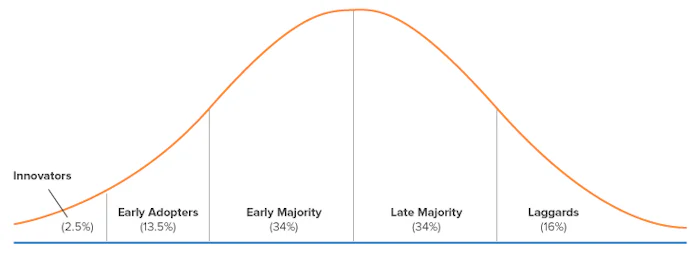
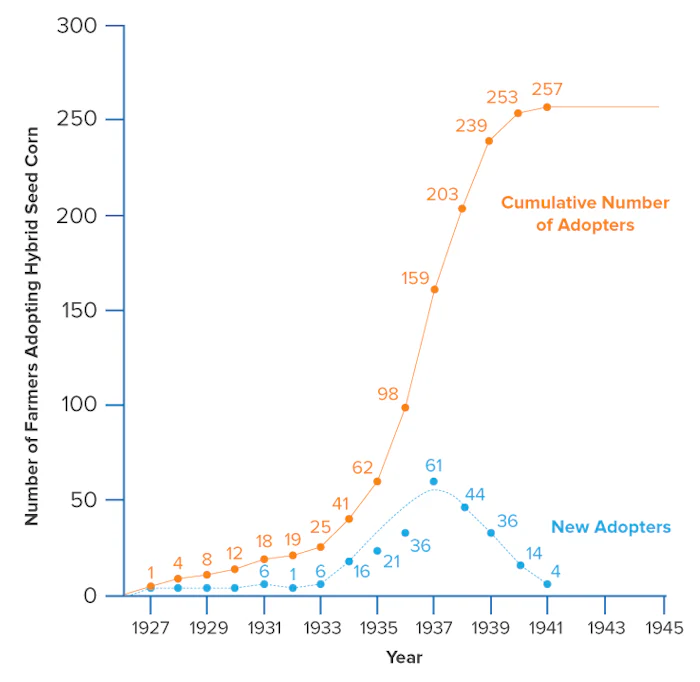
Figure 2, below, is a real-life example of an early Product Diffusion Curve. It shows the take-up of hybrid seed corn over time by farmers in Iowa, U.S. The diagram shows the number of new adopters, and the cumulative number of adopters.
Figure 2: New and Cumulative Adopters Each Year of Hybrid Seed Corn
Access the essential membership for Modern Managers
Figures 1 and 2 from DIFFUSION OF INNOVATIONS, 5TH EDITION by Everett M. Rodgers. Copyright © 1995, 2003 by Everett M. Rogers. Copyright © 1962, 1971, 1983 by The Free Press, A Division of Simon & Schuster Inc. Reprinted by permission of Free Press, a Division of Simon & Schuster, Inc.
You can combine information from the likes of figures 1 and 2 to create a graph such as figure 3, below.
Figure 3: The Product Diffusion Curve
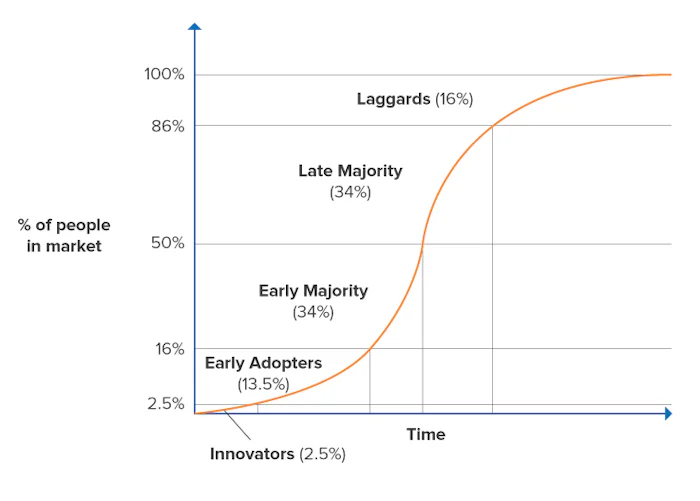
(This Mind Tools diagram is for illustrative purposes only and is not taken from, or endorsed by, Simon & Schuster Inc.)
Access the essential membership for Modern Managers
How to Use Product Diffusion Curves
Think about where your product is in its life cycle. Is it new, and about to be introduced? Or is it well established in the market and understood by the majority of people?
Then think about the marketing message that you're using. Is it appropriate to the group of people that the Product Diffusion Curve indicates you're likely to be selling to?
You'll need to approach different groups with different marketing messages if you're to sell effectively to them. In fact, your whole marketing approach (including pricing) may need to change if you're going to get the next group to adopt your product.
For example, when you're introducing a radically new product, you'll likely want to create a buzz among journalists and readers of specialist blogs, promoting it as the latest piece of exciting, expensive, hi-tech equipment. These are the Innovators who you need to win over if you're then to sell to other groups.
However, if you're using the same pitch to members of the Late Majority, you'll probably scare off more people than you attract! Late Majority buyers are more likely to welcome simplicity and reliability rather than hi-tech gadgetry.
Access the essential membership for Modern Managers
Key Points
It can be challenging to push any new product into a busy and competitive marketplace, and it's often even harder to persuade consumers to purchase the product. One message just will not fit all.
By helping you to identify people as Innovators, Early Adopters, Early Majority, Late Majority, and Laggards, the Product Diffusion Curve can inspire the different marketing approaches that you'll need as your product increasingly penetrates the market.
Share this post
Discover more content

Simonson and Rosen’s Influence Mix
Find out what factors influence customer purchases, and learn how you can make these factors work for you.

Market Segmentation
How can you meet the various needs of different customers? Use market segmentation to deliver products that satisfy all your customers and boost loyalty.

Social Selling
Social selling helps you transform online sales prospects into valuable clients. Follow these nine steps to implement an effective social selling strategy.