


Think back to a time when you had to learn a new skill. Maybe you were put in charge of a new or different part of the production process. Or perhaps the computer system you'd become comfortable with was suddenly replaced. Remember how tough it all felt at the start?
But a few months down the line, you were probably so confident that you wondered why you ever struggled in the first place!
There's an explanation for this: you're benefiting from your journey on a "learning curve." When your performance improves with experience, and it takes less time and effort to complete a task after you've done it for a while, that's a learning curve in action.
In this article, we'll explore how learning curves can help you and your organization to plan, support, and evaluate learning. Also, we'll examine how they can be used to help your people to learn faster, and to cope with change.
The Origins of Learning Curves
Access the essential membership for Modern Managers
Learning curves were first described in research by aeronautical engineer T. P. Wright in 1936. [1] He was studying how long it took to produce airplane parts. As workers gained experience, Wright saw that they were able to produce the parts faster. Efficiency improved – up to a point.
Eventually, the speed of improvement slowed. When the time savings flattened out, the learning was "complete."
Wright showed that this process could be illustrated on a graph, providing some valuable predictions about learning and its impact on business.
Note 1:
There's been research done in many different sectors since, producing very similar results. A study of heart surgeons, for example, revealed a clear learning curve during the first few years of their career. [2]
Note 2:
Don't be misled by the common phrase "a steep learning curve." Learning can certainly feel like an uphill struggle, but learning curves actually focus on things getting easier over time. Used well, a learning curve can be an extremely positive performance tool.
Understanding the Tool
Here's a classic example of a learning curve, focusing on productivity. In the graph below, the time it takes to produce a "unit" is plotted on the vertical y-axis, and the number of units produced is shown on the horizontal x-axis. This creates a curve with a downward slope (figure 1).
Figure 1: Example of a Learning Curve
Access the essential membership for Modern Managers
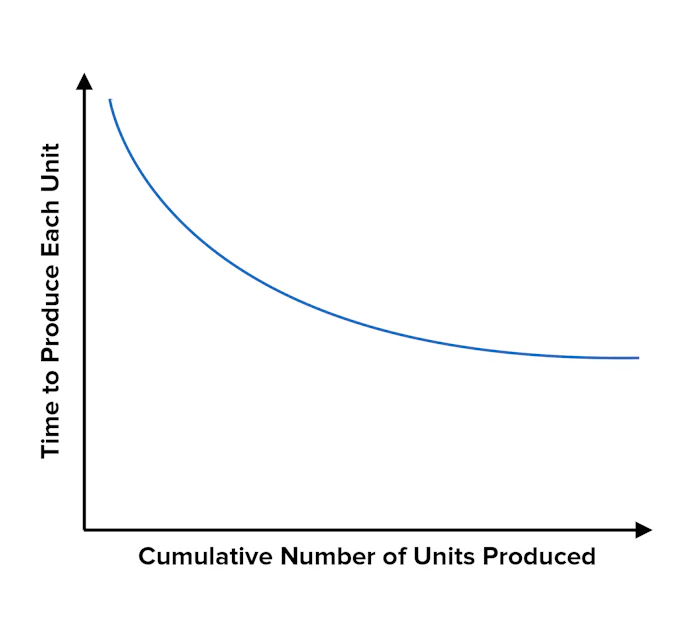
For example, imagine you lead a team that builds handmade picture frames, and you've just introduced a new style. Your people will likely have to make quite a few of the new frames before mastering the new style. But when they have, productivity levels should stabilize, and manufacturing times "level out."
Understanding the learning curve will help you to predict your productivity, so that you can have more confidence when managing orders – and when communicating with customers.
The slope of the line reveals the rate of learning by your team. The steeper the slope, the faster they're learning!
And, if you're not happy with the pace of change, you'll need to find ways to accelerate it – such as adding to your workforce, or removing some of their existing responsibilities.
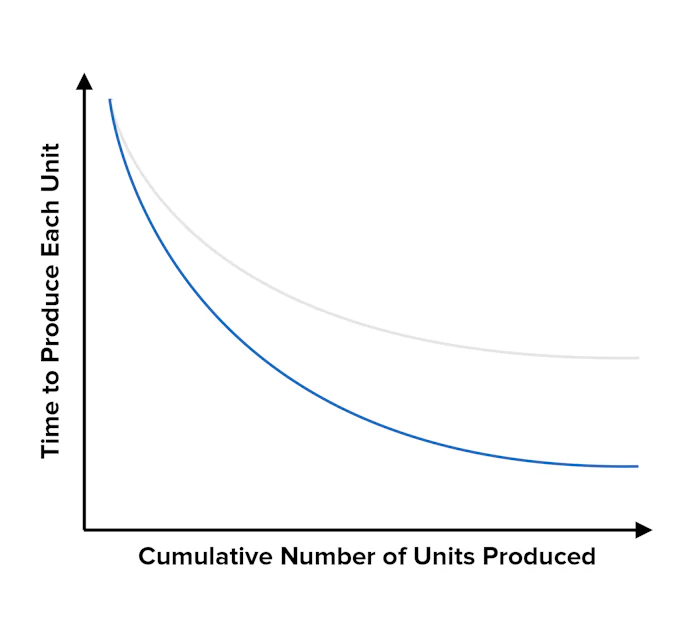
Compare this with figure 2, below, which shows a higher rate of learning. In this example, improvements in productivity are happening faster, and the period of inefficiency doesn't last as long.
Perhaps these units are machine-produced tokens, and the skills needed to make them are easier to learn. On the other hand, maybe this company is just better at supporting effective learning!
Access the essential membership for Modern Managers
Figure 2: Example of a Faster Learning Curve
Note:
The graphs above demonstrate why this kind of "productivity" learning curve is a downward slope – despite the way it's often described.
Many people talk of "climbing" a "steep learning curve," emphasizing how hard a task can feel to learn at first.
However, a learning curve like this actually slopes downward, because performance is getting easier over time. And the steeper the curve, the faster the improvement.
Learning Curves in Business
When an organization makes changes, or its people have to learn new skills, understanding learning curves can be very beneficial for business.
To boost the efficiency of new production processes, for example, you could use a learning curve to forecast your resource needs.
Access the essential membership for Modern Managers
Imagine a carpentry firm had decided to change one of its manufacturing processes. For a while, its workers could be expected to make more mistakes than usual. A knowledge of learning curves could help managers predict how long the difficulties would last – and even estimate how much spare timber to order in the meantime!
Learning curves can also be useful when you're working out your staffing plans. That's particularly important in the period just after a change comes in.
For example, if you're installling new software in a large organization, you can expect to need more support staff on hand for a while. Tasks that used to seem "easy" may take people considerably longer than usual, and reports of problems will likely increase.
Later, when everyone's had more chance to use the software, there should be fewer calls for help. You can plan to reduce the support you provide. User confidence is set to improve considerably – and if it doesn't, you'll know to ask why!
Tip:
Learning curves can reassure your people, showing them why new work feels harder – and promising easier times to come.
Later, if they wonder why their productivity gains are tailing off after an initial surge, learning curves will show them that it's just a normal part of the process. That should also help to guard them against the dangers of perfectionism.
Experience Curves
Business consultancy The Boston Consulting Group (BCG) developed a model called the experience curve. This extended the idea of learning curves to include entire organizations.
Access the essential membership for Modern Managers
Rather than just focusing on productivity, experience curves measure overall efficiency – depending on a variety of factors.
In this model, individuals' learning curves are only part of the story. A company's performance may change over time for other reasons, too, such as growing industry knowledge, advances in technology, and improved economies of scale.
How Learning Curves Support Learning
Even if your work doesn't rely on producing "units," or put a high priority on efficiency, learning curves are still valuable tools.
They're clear visual models for explaining how learning works in general. They can also help you to understand and address the emotions involved at different points in the process.
Note:
We explore the emotional side of learning in more depth in our articles on the Change Curve, and the Conscious Competence Ladder.
The start of a learning curve is where you can make the greatest gains – if you put in the right kind of work. Our article on Purposeful Practice explains how to set strong goals, adopt the best mindset for learning, and structure your practice intelligently.
Access the essential membership for Modern Managers
Other strategies for speeding up learning at key points on the curve include developing effective training programs, and ensuring that extra help is available when required.
And at every stage, the 70:20:10 model emphasizes the role of experience-based learning, or "learning by doing."
Limitations of Learning Curves
The learning curve model assumes that taking less and less time to do something is always good – and always possible. Typical applications are in manufacturing, construction, and document processing.
Sometimes, however, a specific learning curve doesn't apply, especially if any of the following are true:
- Production is irregular.
- Production quantities are small.
- Products are highly customized.
In situations like these, experience tends to bring fewer benefits. Each task presents a new learning challenge, and people aren't repeating the same skills.
Access the essential membership for Modern Managers
Another potential limitation is the cost of investment. Before using a learning curve to justify implementing a change, do some Cost-Benefit Analysis. That way, you'll know whether you're likely to save more from faster learning than you'll pay to achieve it!
Key Points
Learning curves describe how learners benefit from experience.
Understanding learning curves can help you to prepare for times of lower productivity, and to provide extra support to ensure that efficiency improves as expected.
Learning can be an emotional process. Learning curves help people to understand what they're going through – and why.
Learning curves can prompt you to find new ways to speed up learning within your organization, and show you how to do so in the most cost-effective way.
Share this post
Discover more content

Jay Cross: Informal Learning
Jay Cross is an internationally recognised expert in organisational learning. Here we consider his views on how informal learning will change the way organisations approach their development strategies.

Blended Learning
This overview of blended learning describes the key aspects of a blended learning strategy and offers practical suggestions when embarking on a blended learning programme.

Action Learning
This article examines the key principles of action learning as described by Reg Revans, pioneer of the concept.