Access the essential membership for Modern Managers
Managers often talk about performance. There are targets and objectives to achieve – at an individual and team level – to meet your organization's overall goals.
But how do you measure performance? Sure, you know that your team works hard, and you likely have data to back it up. But is everyone working on the right things? Does their work achieve the outcomes that your team and organization need?
Key Performance Indicators (KPIs) can enable you to answer these questions, by quantifying individual and organizational goals, and evaluating performance accordingly. This article explains what KPIs are, what they do, and how to use them effectively.
What Is a KPI?
A Key Performance Indicator (KPI) is a quantifiable metric that reflects how well an organization is achieving its stated goals and objectives.
For example, if one of your goals is to provide superior customer service, you could use a KPI to target the number of customer support requests that remain unsatisfied at the end of each week. This will measure your progress toward your objective.
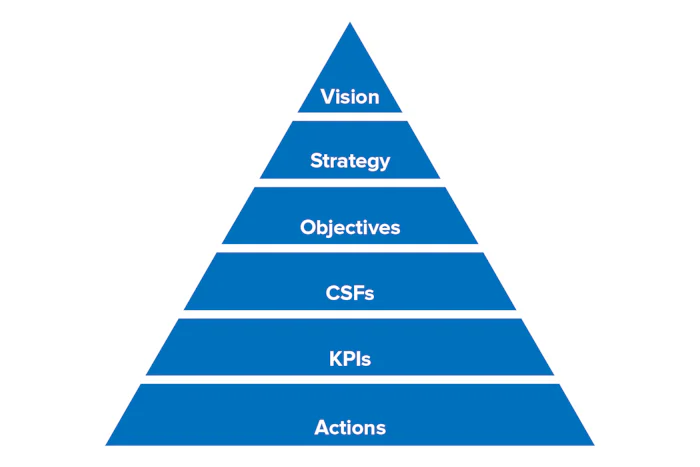
KPIs link organizational vision to individual action. An ideal situation is where KPIs cascade from level to level in an organization. You can visualize this by thinking of your organization as a pyramid, as shown in Figure 1, below.
The pyramid has strategic vision at the top, feeding down to specific actions at the bottom. In the middle you'll find the KPIs that have been derived from the strategy, objectives, and Critical Success Factors (CSFs) of your organization.
CSFs are the areas of activity in which your organization must perform well in order to be successful. KPIs are the means by which these CSFs can be measured. The actions below the KPIs are the tasks and projects that you carry out in order to achieve the KPIs.
Figure 1 – How KPIs fit into an organizational structure.
Used well, KPIs support your organization's goals and strategy. They allow you to focus on what matters most, and to monitor your progress.
How to Set Organizational KPIs
First, your organization needs to choose KPIs that measure the appropriate activity for each area of the business.
For example, net profit is a standard KPI for an organization's financial performance. It's easy enough to calculate (total revenue minus total expenses), and you know that the higher it is, the better the company is performing.
Others may be harder to calculate. A customer satisfaction KPI, for example, may require regular, carefully constructed customer surveys to build the right amount of data. You'd then have to decide what sort of customer satisfaction score represents the benchmark you want to achieve.
Note:
Try not to have too many KPIs: the optimum number for most areas of a business is between four and 10. Just make sure that you have enough to measure how your team or organization is performing against your key objectives.
Setting SMART KPIs
Whatever the nature of your KPIs, you need to make sure that they're SMART. This stands for:
- Specific: be clear about what each KPI will measure, and why it's important.
- Measurable: the KPI must be measurable to a defined standard.
- Achievable: you must be able to deliver on the KPI.
- Relevant: your KPI must measure something that matters and improves performance.
- Time-Bound: it's achievable within an agreed time frame.
When you finalize a KPI, it should fulfilll all of these SMART criteria. For example, “Increase new paid sign-ups to the website by 25 percent by the end of the second quarter of the financial year.”
Ask yourself the following questions to help you to understand the context and define effective KPIs:
- What is your organization's vision? What's the strategy for achieving that vision?
- Which metrics will indicate that you are successfully pursuing your vision and strategy?
- How many metrics should you have?
- What should you use as a benchmark?
- How could the metrics be cheated, and how will you guard against this?
Managing Your KPIs
When you're deciding which KPIs to set up, plan how you'll capture the information you need. Net profit requires a different set of data than customer satisfaction, for example, and requires access to different systems.
Also, establish who will collect the data, and how frequently. Sales data can usually be collected daily, for example, whereas KPIs that require data to be collated from a number of sources might be better measured weekly or monthly.
You'll need to verify the data, too, to make sure it's accurate, and that it covers all the requirements of your KPI.
Communicate KPIs clearly to everyone concerned. If you're responsible for a team or organizational KPI, make sure that your reports know how each KPI impacts their work, and that they know which activities to focus on. You may be able to set up a performance dashboard, or use a balanced scorecard to measure progress efficiently.
How to Set Individual KPIs
"What gets measured gets done" is a common management saying. If you set a goal around a desired outcome, the chances of that outcome occurring are much higher, simply because you have committed to managing and measuring your progress toward it.
When you set goals and KPIs with individual team members, make sure that they align with your team's overall strategy – which, in turn, aligns with the overall strategy of your organization.
Defining an employee's goal with an organizational KPI ensures that their daily activities are well aligned with the goals of the organization. This is the critical link between employee performance and organizational success.
Using KPIs: an Example
Here's an example of how organizational strategy cascades down to an individual team member's goals and KPIs:
- Organizational Vision: to be known for high customer satisfaction and superior service.
- Organizational Objective: to reduce the number of dissatisfied customers by 25 percent.
- Organizational KPI: the number of customer complaints that remain unresolved at the end of a week.
- Team Member's Goal: to increase the number of satisfactory complaint resolutions by 15 percent in this period.
- Team Member KPI: the weekly percentage difference in complaints handled that result in satisfied customers, as against unsatisfied customers.
Using KPIs for Recognition and Development
When you are satisfied that you have meaningful KPIs to measure the performance of your team, and of your organization as a whole, make sure that the appropriate training, support and incentives are in place to enable your people to perform well.
Remember: what gets measured, gets done. But what gets rewarded gets done, too!
When you establish your rewards and recognition practices, make sure that they relate directly to the KPIs you've set, and that you're not rewarding potentially counterproductive behaviors.
For example, if you want to measure people on how well they deal with customer complaints, then rewarding them for reducing the number of complaints confuses the message you're trying to send.
Intuitively, you may feel that the fewer complaints you receive, the better your customer service must be. But this is not necessarily true: you may be getting fewer complaints because you have fewer customers, or because your customers can't access your support services.
Conversely, if your organization wants to attract new customers, then you might have a KPI that measures how many new customers you gain each week. Depending on the situation, a well-aligned performance system may reward employees based on the number of new customers they personally help to attract.
Key Points
A Key Performance Indicator (KPI) is a quantifiable measurement that shows how well an organization, team, or individual is performing against a predetermined goal or objective.
KPIs can be applied to any area of performance, and should align with the organization's critical success factors and its stated vision and strategy.
Avoid having too many KPIs, and ensure that they are Specific, Measurable, Achievable, Relevant, and Time-Bound (SMART).
Communicate KPIs clearly to everyone concerned, manage data collection carefully, and support your people to achieve the outcomes you need.