

- Content Hub
- Leadership and Management
- Change Management
- Change Management Models
- The Burke-Litwin Change Model

Access the essential membership for Modern Managers
Change is the only constant – or so the adage goes. Change is often a complex and arduous process, and not something you want to attempt without a solid plan. When organizations need to change, that planning process is often complicated by the need to change many elements in unison.
This interrelatedness of organizational parts can contribute to the failure of change programs. When one variable is missed, bypassed, or underestimated the whole system fails to change, leaving managers and employees with the unenviable task of putting things back to the status quo. The really brave will attempt the change process over again; others will accept defeat and resign themselves to doing what they've always done.
When what people have always done already isn't working, however, the results of failed change can be devastating. Whether it's revamping an accounting process, implementing a new IT system, or embarking on a new competitive strategy, positive change is revitalizing and productive. That's why it is so important to understand what needs to be addressed during any change process and why.
When you understand the dynamics of organizational change, you can apply the principles to any type of change initiative that comes your way. That's an exciting and valuable skill to have and one that will make you a hot commodity in today's workplace.
A useful model for understanding the organizational change process is the Burke-Litwin Change Model published by George H Litwin and W Warner Burke in 1992. This model shows the causal effects of change between 12 key areas of organizational design. Using the model, you can learn which organizational variables to change and why. You can then use this understanding to analyze, diagnose and even predict the effects of change throughout an organization.
Understanding the Model
The Burke-Litwin model is used as a guide for identifying and linking factors that are critical to a successful change initiative. According to the model there are 12 of these critical factors.
Tip:
This diagram looks very complex. Please persevere! This is a useful tool, and this should all eventually make sense!
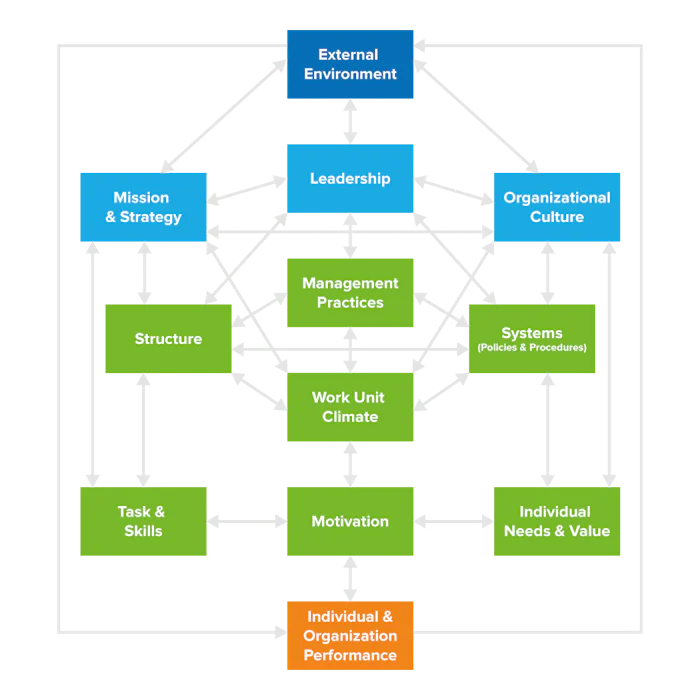
Input: External Environment
The loop starts with the external environment, shown in dark blue in figure 1. This is what creates the need for change. Examples in include a weakening in the economy, shifts in social trends, and the arrival of new technology.
By including the external environment as an input, the Burke-Litwin model goes one stage further than the Congruence Model of organizational performance. It is also considerably more complex, involving more elements. In developing their model, Burke and Litwin tried to strike a balance between reflecting the genuine complexity of the real world, and creating something that people could readily understand and use.
Throughput: Transformational Factors
Transformational factors are the elements that are core to an organization's performance. They make up the fundamental structure of an organization and are shown in sky blue in figure 1. If you're going to make significant changes to your area, or transform an organization, you need to address these factors.
- Mission and Strategy – What the organization's people believe to be the core purpose for the organization's existence;
- Leadership – The actions, philosophies, and values of senior managers; and
- Organizational Culture – The norms of behavior and values that are accepted and expected within the organization.
To effect significant change, or even perform at acceptable levels, these three elements must be aligned.
In the model, these factors are at the top of the loop and are of over-riding importance when dealing with a change that is intended to shake-up "the way things are done around here." The arrows showing the interaction between these transformational factors and the transactional factors described below are shaded downwards to indicate that, although the upper and lower elements both impact each other, the impact is stronger in the downwards direction.
Throughput: Transactional Factors
These are the elements of an organization that are more easily changed, but rarely have the same kind of impact on organization-wide performance as the transformational ones. They are shown in light green in figure 1. They are important, but unless the three transformational factors support the change, modifications in these areas are likely to be temporary.
- Structure – The way the organization is set up in terms of roles and functions, communication, lines of authority, and decision-making.
- Systems – The processes and procedures that are in place to support operations.
- Management Practices – How managers and people with authority and responsibility execute the strategy on a day-to-day basis.
- Work Climate – The prevailing attitude and morale of the people working for the organization.
- Task and Individual Skills – The degree of "fit" between the skills required for the job and the skills of the people doing the job.
- Individual Needs and Values – The degree to which the processes and systems within the organization fulfilll the needs of the employees and allow them to feel satisfied.
- Motivation – The intrinsic and extrinsic factors that motivate people to perform well on a consistent basis.
In fact, all twelve elements affect each other, but the arrows on the diagrams show the relationships between elements that the authors considered the strongest. Even so, it quickly becomes clear how a change in one element can have an organization-wide impact. And while change or improvement in any one of these transactional factors can affect performance, the effect will only be long-lasting if the underlying transformational elements are aligned.
For example, if you restructure departments and create cross-functional work teams without addressing the deeply held belief that functional groups operate best as distinct business units, then your restructuring may even be detrimental to performance. Likewise, if you put in place a top-notch reward and recognition system to motivate employees, but it doesn't reward people for behaviors that support the mission, then the effect may be counterproductive.
Output: Individual and Organizational Performance
The outcome of the change is the effect it has on performance (shown in gray in figure 1). This is the measure of the effectiveness of the change. It also has an impact on the external environment, which is what creates the loop. Therefore, as the output changes, so does the input and so the factors of change themselves also change, once again proving that the only constant is change!
Applying the Burke-Litwin Change Model
So the theory sounds good, but how do you use it? The model's greatest value is as a framework for understanding the current situation and the collateral impact of proposed changes.
Step 1: Where Is the Need for Change Coming From?
Change initiatives are driven by one of two things: either something isn't working now, or something won't be working as well as you want it to in the future if you don't make changes now.
Either way, the change initiatives will be focused in one of the four groups of elements in figure 1:
- The External Environment.
- Transformational Factors.
- Transactional Factors.
- Performance.
Start by deciding which group your change imperative belongs to. Then identify which of the elements in each group is key for your situation.
In general, the lower down the model your key element is, the more easily you will be able to effect the change required.
Example:
A small software development company had grown successfully over several years, and now employed around 60 people. However, in the last 9 months, staff had started leaving. Karen, one of the founders, set about finding out why this was happening.
She contacted some of the recent leavers and found that they had been unhappy with a new emphasis she and her business partner had put on developers selling work to clients. In the past, she and her partner had cut the deals. But as the company had matured, the founders had wanted to put more of their time into a new venture, and had figured that selling software required strong technical knowledge, so the developers themselves would be well placed do to this. While this was essentially true, the problem was that the developers didn't like doing this task, and they also felt they lacked sales skills.
Using the Burke-Litwin Model, Karen concluded that "Task and Skills" was the key problem area.
Step 2: Assess the Current Situation
The next step is to understand the key element in your change imperative in detail. Use the questions from the following list as a guide, and also explore the other 11 elements, spending more time on those that Figure 1 links most closely with your key element.
- External Environment – What is driving the change? How will these drivers impact the organization?
- Mission and Strategy – Is there a clear mission? What is it? Is there a perceived mission and strategy that is different from the formal one? Do employees believe in the mission and strategy?
- Leadership – Who are the real leaders? What style do they use? Is this style successful?
- Organizational Culture – What are the unwritten rules of behavior? Do any of these rules conflict with what the organization is seeking to accomplish?
- Structure – How are people and functions arranged? How flexible is the structure? Where are decisions made? How is authority and responsibility divided up? How is information communicated?
- Systems – What are the key policies and procedures that define how work is done? What systems are in place to motivate, reward, recognize, appraise, and compensate employees?
- Management Practices – What style of management is practiced? How do managers interact with their employees? Are teams used?
- Work Climate – What is the morale of the staff like? How do people get along with each other? What systems are used to resolve conflict? Are there definite dividing lines between units, departments, or locations?
- Task and Individual Skills – How are job requirements defined? Who defines them? How well are people matched to their jobs?
- Individual Needs and Values – Are people generally satisfied at work? What efforts are made to ensure job satisfaction? What opportunities are given for professional development and career succession?
- Motivation – Are staff motivated through formal systems? Is motivation expected to be intrinsic? What impacts motivation the most?
- Individual and Organizational Performance – How is productivity measured? What are the performance levels on these factors? What should be measured that isn't?
Example:
Karen looked at the following elements of the Burke Litwin Model which are the most closely linked to the key problem area of Task & Skills.
- Task and Individual Skills: The new requirement to sell work had not been properly discussed with the developers before it was brought in. The approach came entirely from the founders, who loved selling; they hadn't appreciated that developers who thrived on satisfying customer needs might not enjoy brokering the deal too.
- Structure: As the company had grown, its structure had not grown with it. All developers essentially had the same job description. Karen and her business partner made all the decisions.
- Mission and Strategy: The company's growth targets had not been adjusted to reflect the change in approach to sales.
- Leadership: Karen and her business partner were spending less time on the business, yet had not appointed anyone else to take over the parts of the leadership role they had vacated. They were charismatic leaders, so once they were not as involved, employees felt that the business lacked direction.
- Motivation: Employees were demotivated by having to do work they didn't enjoy and felt they were no good at. A reward system had been introduced to give bonuses based on the revenue generated by each developer, but employees felt that they could not access these bonuses as they were not good enough at selling work.
- Individual Needs and Values: The developers who had left wanted to be able to focus on development work and on surpassing the expectations of clients who had already decide to "buy" from them. They did not want to have to work on winning round clients, and did not particularly value high sales bonuses.
- Individual and Organizational Performance: Individual performance was dropping as developers had spent less time on development, and were not successful in their selling work. Organizational performance dropped as less work was being won.
Step 3: Incorporate All Affected Elements Into Your Change Plan
Now that you understand "what" is happening, you need to figure out what you're going to change in the key problem element, and what therefore also needs to change in the main related elements.
This may need to be done as an iterative process: change in one element affects a second element, which affects a third, yet the change in the third element may require another alteration back in the first element again.
Example:
Karen consulted with her team of developers and, together, they agreed a new approach:
- Task and Individual Skills: Selling work would no longer be required of developers.
- Structure: A new sales team would be formed, headed up by a professional sales executive. The team would include several hybrid developer-seller roles, offering an opportunity for those developers who had enjoyed doing selling work. Developers who applied for these roles would be given sales training.
- Mission and Strategy: Karen and her business partner recognized that their interests were focused on their new venture, and so revised their growth expectations for the software company.
- Leadership: A new Chief Executive was appointed to run the software company, with the founders moving to Chairman/Advisor roles.
- Motivation: Intrinsic motivation increased greatly as employees no longer had to do types of work for which they felt they were not suited. The reward system was enhanced to recognize developers who maintained long-term relationships with clients, as well as developer-sellers who brought in new work.
- Individual Needs and Values: The developers now felt that a range of opportunities was available to satisfy their individual needs and values.
- Individual and Organizational Performance: Individual and organizational performance improved.
Tip:
For another similar approach to this, see our article on the McKinsey 7S Model. You may also find our articles on the Change Curve, Impact Analysis and Lewin's Change Management Model useful.
Key Points
The Burke-Litwin Change Model examines organizational change and provides insight into how changes in 12 key elements of the organization's design can impact one another and overall performance. While it doesn't show us how to make the changes needed to these critical factors, it does provide a useful framework from which to analyze what needs to be done, and why.
This framework can be used to keep a close eye on the impact that changes in one area have on all the other areas as development and implementation of a change plan continues. The more aware you are of the dynamics of change, the better you will be at managing and dealing with it as it happens.


