Access the essential membership for Modern Managers

Reflecting on experiences can help people deal with them better in the future.
Many people find that they learn best from experience.
However, if they don't reflect on their experience, and if they don't consciously think about how they could do better next time, it's hard for them to learn anything at all.
This is where Gibbs' Reflective Cycle is useful. You can use it to help your people make sense of situations at work, so that they can understand what they did well and what they could do better in the future.
What Is Gibbs' Reflective Cycle?
Professor Graham Gibbs published his Reflective Cycle in his 1988 book "Learning by Doing." It's particularly useful for helping people learn from situations that they experience regularly, especially when these don't go well.
Gibbs' cycle is shown below.
Figure 1 – Gibbs' Reflective Cycle
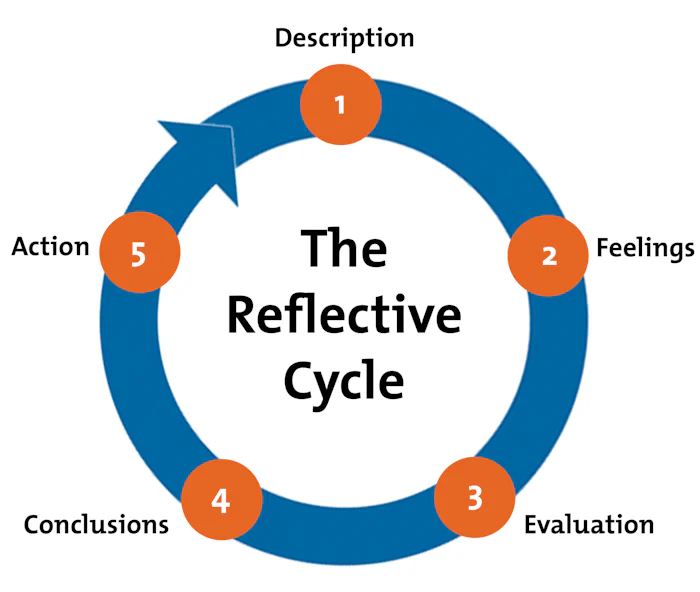
Figure 1 - Gibbs' Reflective Cycle
From "Learning by Doing" by Graham Gibbs. Published by Oxford Polytechnic, 1988.
Note:
Gibbs' original model had six stages. The stage we haven't covered here is "Analysis" – we've included this as part of the Evaluation stage.
Using the Model
You can use the model to explore a situation yourself, or you can use it with someone you're coaching – we look at coaching use in this article, but you can apply the same approach when you're on your own.
To structure a coaching session using Gibbs' Cycle, choose a situation to analyze and then work through the steps below.
Step 1: Description
First, ask the person you're coaching to describe the situation in detail. At this stage, you simply want to know what happened – you'll draw conclusions later.
Consider asking questions like these to help them describe the situation:
- When and where did this happen?
- Why were you there?
- Who else was there?
- What happened?
- What did you do?
- What did other people do?
- What was the result of this situation?
Step 2: Feelings
Next, encourage them to talk about what they thought and felt during the experience. At this stage, avoid commenting on their emotions.
Use questions like these to guide the discussion:
- What did you feel before this situation took place?
- What did you feel while this situation took place?
- What do you think other people felt during this situation?
- What did you feel after the situation?
- What do you think about the situation now?
- What do you think other people feel about the situation now?
Tip 1:
It might be difficult for some people to talk honestly about their feelings. Use Empathic Listening at this stage to connect with them emotionally, and to try to see things from their point of view.
Tip 2:
You can use the Perceptual Positions technique to help this person see the situation from other people's perspectives.
Step 3: Evaluation
Now you need to encourage the person you're coaching to look objectively at what approaches worked, and which ones didn't.
Ask him:
- What was positive about this situation?
- What was negative?
- What went well?
- What didn't go so well?
- What did you and other people do to contribute to the situation (either positively or negatively)?
If appropriate, use a technique such as the 5 Whys to help your team member uncover the root cause of the issue.
Step 4: Conclusions
Once you've evaluated the situation, you can help your team member draw conclusions about what happened.
Encourage them to think about the situation again, using the information that you've collected so far. Then ask questions like these:
- How could this have been a more positive experience for everyone involved?
- If you were faced with the same situation again, what would you do differently?
- What skills do you need to develop, so that you can handle this type of situation better?
Step 5: Action
You should now have some possible actions that your team member can take to deal with similar situations more effectively in the future.
In this last stage, you need to come up with a plan so that they can make these changes.
Once you've identified the areas they'll work on, get them to commit to taking action, and agree a date on which you will both review progress.
Frequently Asked Questions About Gibbs' Reflective Cycle
What is purpose of Gibbs' Reflective Cycle?
The reflective cycle is a way to better learn from experience. It can be used to help people learn from mistakes, to make sense of situations, and analyse and refelct on their reactions to different situations.
What are the six stages of reflection?
The stages of Gibbs' Reflective Cycle are the following: descrition, feelings, evaluation, conclusion, and action. In the original model Gibbs included a sixth stage, analysis, which we've included in the evaluation stage.
What is the difference between Gibbs and Kolb's reflective cycles?
David Kolb's cycle has only four stages: concrete experience, reflective observation, abstract conceptualization, and active experimentation. Kolb's model is more about explaining the concept of what he calls "experiential learning" – whereas Gibbs' cycle is an attempt to provide a practical method for learning from experience.
Tip:
This tool is structured as a cycle, reflecting an ongoing coaching relationship. Whether you use it this way depends on the situation and your relationship with the person being coached.
Key Points
Graham Gibbs published his Reflective Cycle in 1988.
There are five stages in the cycle:
- Description.
- Feelings.
- Evaluation.
- Conclusions.
- Action.
You can use it to help team members think about how they deal with situations, so that they can understand what they did wel and where they need to improve.



