

- Content Hub
- Leadership and Management
- Leadership Skills
- Leadership Models And Styles
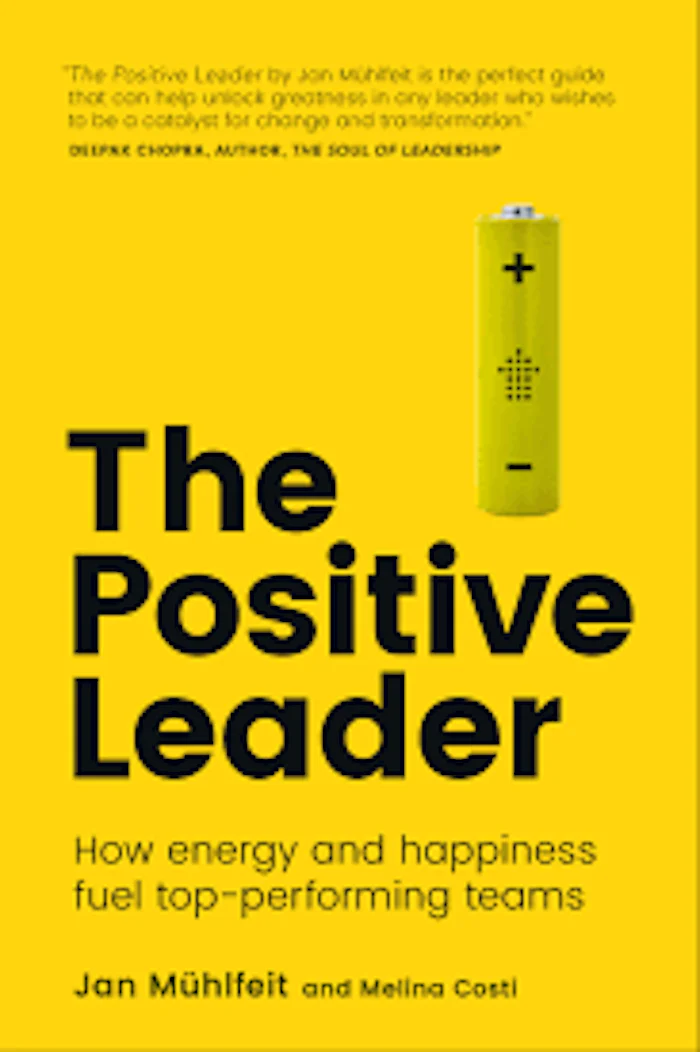
- The Positive Leader: How Energy and Happiness Fuel Top-Performing Teams
The Positive Leader: How Energy and Happiness Fuel Top-Performing Teams
by Our content team
Access the essential membership for Modern Managers
By Jan Muhlfeit and Melina Costi
Transcript
Welcome to the latest episode of Book Insights, from Mind Tools. I'm Cathy Faulkner.
In today's podcast, lasting around 15 minutes, we're looking at "The Positive Leader: How Energy and Happiness Fuel Top-Performing Teams," by Jan Mühlfeit and Melina Costi. This how-to book presents a four-point approach to becoming an inspirational leader, creating a happy team, and achieving top performance. It harnesses the fundamentals of positive psychology for practical use in the workplace.
Good leadership tends to be valued in terms of performance, productivity and profits, and the authors agree that these criteria are an indication of success. But the traditional way to achieve these things, which often focuses on working long hours and trying to "fix" people's weaknesses, doesn't sit well with the authors. They believe the route to success is happiness.
Studies show that, when people are happy, they're far more likely to be successful. So, if leaders focus on inspiring and positively engaging their teams, the rewards of top performance, increased productivity, and greater profit will follow.
It may sound like a tall order, but it does make sense. Think about a recent project you put a lot of effort into. It was probably one you were happy to work on. How much easier is it to fully engage in something you love than something in which you have little interest?
It's this passion and engagement that the book aims to unleash, by encouraging leaders to focus on what people do best. And according to the authors, this isn't just the best way to operate, it's essential.
As technology evolves and becomes ubiquitous, organizations need something that differentiates them from their competitors. One way to stand out, the authors maintain, is through the talents of their people. So organizations need to be good at unlocking their workforce's potential.
This requires charismatic leaders who can get the best out of people – leaders like Winston Churchill, Steve Jobs, and Mother Teresa, who are as disparate as they are successful. Leadership comes in many flavors. But the authors say good leaders do have at least two things in common. Firstly, they think and act positively. And, secondly, they don't sacrifice their personality to conform to someone else's idea of a good leader.
And that's why this book doesn't attempt to squeeze you into the straightjacket of a leadership style. With the guidance of "The Positive Leader," you'll be exploring your uniqueness and designing your own charismatic and comfortable leadership approach. Clearly, this may take more effort on your part than trying on someone else's leadership suit. But the authors maintain that this bespoke approach will be far more long-lasting.
Positive leadership is for leaders at any stage in their career – from novices to seasoned old hands – who see the working environment as a place where people can flourish, and are prepared to champion happiness as the route to success. You can even use the book to lead yourself to personal excellence.
So, let's get started on your journey to becoming a positive, charismatic and visionary leader, who inspires a happy team to fulfill their greatest potential.
Our guiding lights on this journey are Jan Mühlfeit and Melina Costi. Mühlfeit is a global strategist, executive coach and former chairman of Microsoft Europe who learned positive leadership the hard way. The stress and long hours of working relentlessly toward high performance led to a breakdown early in his career. That's when he re-thought his leadership strategy and came up with positive leadership – an approach he credits partly to having Microsoft founder Bill Gates as his role model.
He's currently a coach for MBA students at Cambridge University in the UK, and is a member of the Business Advisory Board at Imperial College London, specializing in helping prominent individuals and organizations deliver exceptional performance.
Costi is a business writer and teacher, who co-authored the bestselling book "GRASP the Solution" with Chris Griffiths.
So, keep listening to find out why you should dump the tasks you're not good at, how recognizing when you're in the flow increases your motivation, and why multitasking is not as productive as you might think.
"The Positive Leader" is crammed with theory, research, practical tips, and tools. It's a comprehensive guide to personal fulfillment and becoming a happier and more successful leader.
Each of its four parts deals with one of the four Ps of positive leadership: people, purpose, process, and place. In each part there are ideas, business examples, and tools to adapt and apply. With data and research to support the ideas, plus anecdotes from Mühlfeit's own life, the book feels both professional and authentic.
The tone is friendly and the writing accessible, providing reassurance that you, too, can be a positive leader. Sub-headings, shaded text boxes, diagrams, tables, and lists are used judiciously for clarity and user-friendliness.
This is a truly interactive book. There are exercises and surveys to complete – most of which are downloadable from the book's website. The book provides you with all the materials; you just need to be prepared to dig deep within yourself, complete the exercises, learn, and act.
The introduction is very useful for readers who like to understand the bigger picture before going into detail. But, if you're the type who likes to dive in, go straight to Part One.
This is all about people – and it starts with you, the leader, becoming more self-aware. The authors argue that when you know your own strengths and vulnerabilities, you become more open and authentic, and are able to interact more skillfully with others.
Self-aware leaders are less likely to have blind spots, and they're wise enough to appreciate others who have greater acumen in some areas than they do. This equips them to achieve more, since they're able to tap into their own strengths as well as those of their team members.
The book presents a number of tools to help you identify your strengths, personality type, how you interact with others, and how well you recognize your emotions – and those of others. Since we can't always be objective, the authors also suggest enlisting colleagues' help by asking them for feedback.
What about harnessing other people's strengths? According to the authors, the most motivating leaders focus on people's talents, rather than trying to fix their weaknesses.
The book cites research by Gallup that found that when people focus on their strengths, they're six times more likely to be engaged, productive and creative. This approach is known as strengths-based leadership and it's grown into a formidable movement. Elements of it have been adopted by such household names as Facebook, Microsoft and 3M.
But we all have weaknesses. So, do we just ignore them? The authors advise avoiding or delegating tasks in areas where you're weak. It's far better to be really good at a few things than mediocre at many, by plugging away at your weak areas. Being brilliant at the things you're already good at boosts your credibility and makes you happier.
Of course, the authors aren't suggesting you can – or should – avoid every task you don't like. But you could use your strengths to put a different slant on something you find tedious. So, if you're a great performer but loathe gathering data for presentations, you could focus on how you can entertain your audience, making the task more appealing for you.
Good teams are created in the same way – by recognizing and utilizing people's strengths. Know the individuals on your team, focus on their talents, and set learning goals to enhance their strengths. This is how positive leaders create positive people.
Part Two focuses on purpose – the "why" of what you and your team are doing. It may be obvious, but when people do something that's meaningful to them, they'll be happy and more likely successful at it. As an individual, it's all about defining a personal mission. But often, it's not easy to distinguish between what has meaning for you and what others expect of you.
So, how do you know when you've found something you're passionate about?
Notice when you're so absorbed in a task that you lose track of time, and the activity itself is intrinsically rewarding. "Being in the flow" is one way we refer to this happy state. When people love doing something, their motivation, focus and commitment increase dramatically. So recognizing when you're in a state of flow is helpful in defining your purpose.
Once you've discovered what makes you and your team tick, you can create a compelling vision of the future. The authors point out that inspiring leaders often see the bigger picture and share this with the organization – propelling everyone forward. Think of Bill Gates's vision for Microsoft in 1977, when he predicted "a computer on every desk in every home." This may have seemed farfetched at the time, but it turned out to be very prescient.
The book provides tools, examples and advice on how to create and share your vision. In a nutshell, you need to include: where you and your team are going, why you need to go there, and your team members' individual roles in helping to get there. Your vision must be exciting and interesting, in some way, to everyone involved.
At this point, your leadership has created a positive, well-motivated team that has an inspiring path to follow. Great! But don't let your team members dash off on full throttle. Your wonderful vision could all go pear-shaped unless you encourage them to pace themselves.
Part Three is all about how to lead your happy team to top performance, by carefully managing people's limited supply of energy.
Research shows that our energy drops after about 90 to 120 minutes, at which point we need to take a break. You could take a short stroll, eat a healthy snack, play music, or take a power nap. As a leader, you should make sure your team isn't risking burnout by working flat out. It's more productive to work on full power for 90 minutes then break for 20 to 30 minutes, rather than slog on relentlessly.
The authors are among those who believe that multitasking isn't very effective – no matter what your gender. Multitasking slows us down and causes us to make more mistakes, they say. People are far more effective when they do one task at a time, and it's a better use of team effort.
Positive leaders make people aware of the importance of pacing their energy. They encourage people to take breaks and use the company's wellbeing facilities, if it has some, and they publicly applaud staff when they do.
By providing your team with a clear and inspiring vision of the future, you'll give them confidence and encourage buy-in. If you promote self-care, they'll know they're valued, and will feel more committed to their work. And if you get to know your people, you can tailor their work so it engages and absorbs them. All these things boost productivity.
Finally, the positive leader pursues happiness, not success. Our brains are programmed to function better when we're happy. So, it makes sense that success follows happiness, and not the other way around.
Part Four is all about pursuing happiness, through the lens of being a good leader – showing the way by "doing the right thing;" giving rather than taking; and being competent, authentic and caring. This includes helping others to find and live their personal mission, and fostering social connections at work, so that people feel they belong. The latter could be as simple as designating a social space in the office or celebrating personal milestones, such as birthdays.
This part of the book gives you tools to appraise your leadership style, and suggestions on how to be a supportive, happy and successful leader – in your own unique way. It also sets out some simple strategies to make people happier on a daily basis.
For instance, when you're having a rough day, it's easy to plunge into negativity. Haul yourself back to positivity by counting your blessings. Recognize all the good things in your life – even small things like beating the rush-hour traffic, a great cup of coffee, or bird song outside your office window. This will get you thinking positively again. Spreading a little kindness works wonders too. Even a fairly simple thing, like offering a ride home to a colleague, creates happiness for both giver and receiver.
So, what's our last word on "The Positive Leader: How Energy and Happiness Fuel Top-performing Teams?"
The authors deliver what they promise – a route to top performance that doesn't depend on long hours, stress and eventual burnout. The book flips the idea that happiness follows success, and shows leaders that, if they aim for a happy team and manage energy sensibly, success will follow.
For many organizations and individuals used to following the maxim of "work, work, work," focusing on happiness and wellbeing as a priority may seem a little unrealistic – at first. So adopting this approach may be best accomplished by taking small steps that you know your team will accept. As a leader, though, you'll need to be fully committed from the get-go.
Working on increasing your self-awareness and sharing your uniqueness – even the bad bits – won't necessarily be easy. But the effort you put in will likely make your working world a better place, now and long into the future. After all, happiness is contagious.
"The Positive Leader: How Energy and Happiness Fuel Top-Performing Teams," by Jan Mühlfeit and Melina Costi, is published by Pearson.
That's the end of this episode of Book Insights. Thanks for listening.


