Access the essential membership for Modern Managers
Also known as Leavitt's System Model *
It seems as if there's an epidemic of change out there! Re-engineering, restructuring, revamping – workplaces today seem to be launching one change initiative after another. But the hard truth is that many change initiatives fail. Why?
The answer may lie in the way we view change. Do you see it as an isolated process? And do you focus only on one part of your organization in isolation? This can be a fatal error.
Everything in an organization is connected, and changing one piece can impact another. This is why change is only likely to be successful if it considers all of those interconnected pieces.
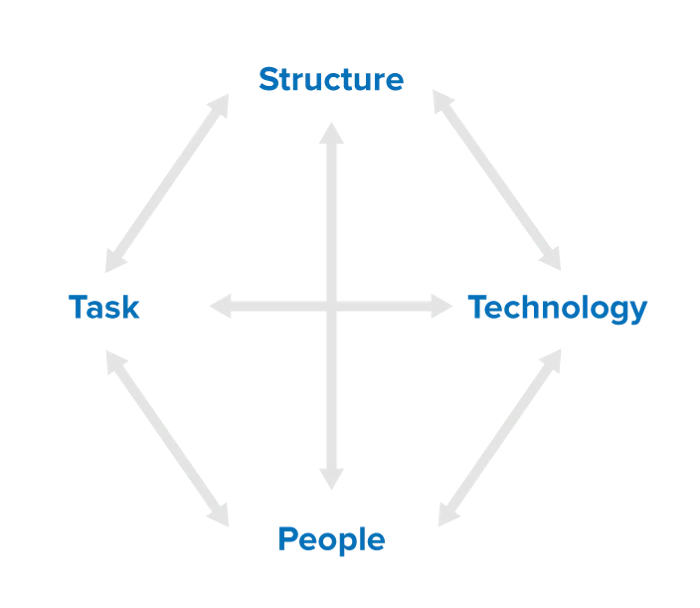
This is where Leavitt's Diamond is useful. Designed by Harold J. Leavitt in 1965, the model is a framework for understanding the connection between the key factors in an organization, and for building an integrated change strategy.
Understanding the Tool
Leavitt's Diamond is based on the principle that an organization has four major components that are all interdependent:
- Tasks.
- People.
- Structure.
- Technology.
Any type of change or redesign in one component will affect the other three.
According to this approach, before you bring about change in any one of the four components, you should evaluate the impact on the other three components. To implement change successfully, you need to find the right balance between all of them.
A classic example is introducing new technology. A change in technology means that people need to change too – they'll need training to use the new technology. This may affect the organizational structure, because people might demand higher pay and better positions. The new technology may also change old tasks. For instance, if the change automates old processes, the work that people do will be different.
How to Use the Tool
Leavitt's model can be a good starting point for any change analysis process. Whether you plan a simple process redesign or a complete organizational restructure, Leavitt's Diamond helps you assess the impact of the proposed change – so you can plan and provide for those impacts in advance.
To use Leavitt's Diamond, follow this two-step process.
Step One: Define Each Component
- Tasks
Identify your work unit's main tasks, including both routine and key tasks. For example, if your work unit is a restaurant, the key tasks could be taking orders, preparing meals, and serving meals. The routine tasks could be cleaning, setting tables, and so on.
To help define your tasks, consider these questions:
- What is the staff expected to do?
- How do staff get work done?
- Why does the work unit exist?
- People
Define the "people" within your work unit. People are often the key consideration in any change initiative, because skill sets and staff attitudes greatly affect the success of change in any organization.
To help define your "people" component, consider the following:
- What are their beliefs, attitudes, and behaviors?
- What is their response to the proposed change?
- What are their skill levels?
- What are they trained to do?
- What are the rewards that motivate them?
- What is their work culture?
- Structure
Determine how people are grouped within the work unit. In other words, what is your organizational structure? If we go back to our restaurant example, the structure could be defined in terms of waiters, chefs, managers, cleaners, and so on.
Ask yourself these questions:
- What is the hierarchy in your work unit?
- Is the unit centralized or decentralized?
- Where is the control at each level?
- How are the work units divided?
- What is the geographical breakdown (if everything isn't at one location)?
- How are duties divided?
- What is the workflow?
- What is the communication flow?
- Technology
Identify the technology that your work unit uses by making these two lists:
- Key equipment and processes that enable and support your business functions, including computer systems, essential software, devices – anything that enables communication and workflow.
- Tools you can use to implement the proposed change, including things such as seminars and training materials.
Step Two: Analyze the Impact of the Proposed Change
Determine how the primary change will impact each of the four components.
The "how-to" of the analysis is best explained through an example. ABC Company has decided to introduce a new skill-based assessment procedure for its field engineers. Under this system, the engineers will be evaluated primarily on their skills. They'll be expected to keep up with the latest developments in their field and use them effectively. Furthermore, instead of the boss, peers will be asked to rate other engineers.
What will the impacts be?
- Task – The primary change will occur in the task component of the diamond. The work unit will have to take on the new task of conducting skill-based assessments. So, what is the impact of this primary change on the other three components of Leavitt's diamond?
- People – Engineers may be uneasy about the new system. They may think "Am I good enough?" "Won't it involve a lot of work?" "Will I have time to track new developments?" "How do I rate my peers?" These concerns will need to be addressed if the change is to be successful.
- Structure – Old career advancement patterns might not align with the new assessment procedure. The new procedure might create a more skilled pool of people. These people, in turn, might demand higher pay and better positions.
- Technology – This change may need changes to be made to computer systems: once established, the new procedure may need a database to store and track the skill-based assessments on an ongoing basis. The organization might also need technology and training seminars to help with continuous learning for engineers.
In summary, ABC Company's analysis revealed that its new assessment procedure is likely to meet a lot of resistance from the engineers. The procedure needs to be supported by an upgrade in technology. Also, the old structure and the new procedure aren't really aligned with each other. For a successful change, ABC Company has to design an integrated strategy that addresses all of these issues.
Using this model, you can conduct a similar analysis for a different change proposal. The key findings of your analysis will become the foundations of your change strategy.
Tip:
Leavitt's Diamond is only one such approach used to look at the impact that change can have on an organization. See also our articles on more recent models like the Congruence Model, the Burke-Litwin Model, and the McKinsey 7Ss.
Also, see our article in Impact Analysis, which helps you think through the impact of change in detail.
Key Points
Change cannot be implemented in isolation, as it can have many knock-on impacts throughout an organization, both expected and unexpected.
Organizations are inter-connected structures, where changing one part can impact many others. Therefore, to implement change successfully, you have to adopt an integrated change strategy. The idea of Leavitt's Diamond can help you build this integrated strategy.
It provides an easy framework for understanding the interdependency between four key variables: tasks, people, structure, and technology. Using this framework, you can analyze the impact of the proposed change and use the results within your implementation strategy.
ReferencesLeavitt, H. J. (1965). 'Applied Organizational Change in Industry: Structural, Technological and Humanistic Approaches. In J. G. March (Ed.), Handbook of Organization. Rand McNally and Company. Chicago, Illinois.