


What are employers interested in when they ask you to do a personality test as part of an interview process? Do they want to know if existing team members will get along with you? Are they interested in finding out what motivates you? Or do they hope to uncover how you think and perceive the world?
All of these things, and more, can be looked at using personality tests. That's what makes personality so fascinating. It's also what makes it such a loaded topic: with so much riding on your personality type, it's easy to try and fit yourself to an "ideal" type.
One of the most common business uses for personality typing is matching people with job types. But when someone has an idea of the kind of profession he or she wants to pursue, or the type of person he wants to be, how likely is it that he will answer a personality test question without some form of distortion, whether conscious or subconscious?
If you've taken a personality test like the Myers-Briggs or DISC, how objective were your answers really? If you're like most of us, your answers were probably tainted, just a bit, with how you want to act, think, behave, or react, instead of purely how you do respond.
It's nothing to be ashamed of; it's just human nature to want to project a desirable image. Unfortunately, this can lead to a poor match between person and job.
The Benziger Thinking Styles Assessment (BTSA) seeks to address this disjoint by looking at different patterns of brain function, and the personality types associated with these.
Access the essential membership for Modern Managers
Benziger's Brain Types
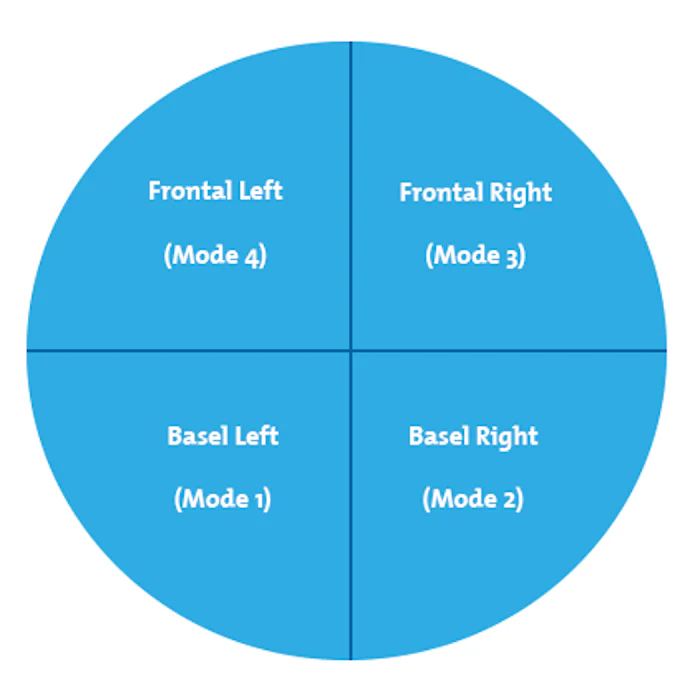
Dr. Katherine Benziger's approach to personality is based on the idea that we all have a dominant and preferred way of thinking. This dominance is determined by the quadrant of our brains that are naturally the most efficient. In Benziger's model, people's brains are separated into four zones.
Each of these zones, or "modes", has specialized functions. Depending on our pattern of dominance, the behaviors and thinking styles represented in each zone are what determine our strengths.
Benziger's Model
Below is an aerial view of the brain and the four corresponding modes as defined by Benziger.
Figure 1 – Benziger's Brain Model
Access the essential membership for Modern Managers
Mode
Specialized Functions/Preferences
Strengths/Characteristics
Basal Left
Seeks order, processes, procedures, systems
Sensing is dominant – realistic, grounded, practical, sensible
Access the essential membership for Modern Managers
Basal Right
Seeks feelings, harmony, spirituality, emotional connections
Feeling is dominant – subjective, takes things personally, values closeness with people,
Frontal Right
Seeks meaning, expresses through images and metaphors, strong imagination
Intuition is dominant – uses hunches and speculations, imagines what the future might bring
Frontal Left
Access the essential membership for Modern Managers
Seeks clarity, criteria, standards, objective measures, benchmarks
Thinking is dominant – analytical, logical, objective, critical
Terms from "The Four Modes," at Benziger.org.
According to Benziger, we all have one mode where we are naturally the strongest. When you are using your most natural thinking style, you are the most effective and least stressed. However, you can, and many people do, develop skill in other less innately efficient modes.
When someone has a second mode that is almost as strong as their dominant mode, for example, their Basal Left mode is almost as strong as their dominant Frontal Left mode, they would be described as having a "Double Left" brain type. Just 5 percent of people are almost equally strong in all four modes: This is called being "Whole-Brained."
Some examples of brain types are as follows:
Access the essential membership for Modern Managers
Brain Type
Strengths
Weaknesses
Professions
Basal Left
(Mode 1)
Deadline oriented, attends to detail, follows instructions
Access the essential membership for Modern Managers
Rigid, averse to changes, lacks creativity
Clerks, supervisors, safety officers
Basal Right
(Mode 2)
Listening, creating harmony, interpersonal skills
Hard to say no, tries to please everyone
Nurses, teachers, trainers
Access the essential membership for Modern Managers
Frontal Right
(Mode 3)
Spatial skills, conceptualizing, creating models, enjoys change
Becomes bored, doesn't finish projects, idiosyncratic
Entrepreneurs, artists, architects
Frontal Left
(Mode 4)
Access the essential membership for Modern Managers
Analytical skills, objective decision making, sound judgment, goal setting
Underdeveloped people skills, willing to break rules to get results
Managers, CEOs, Business analysts
Double Lefts
Modes 1 and 4 combined
Modes 1 and 4 combined
Doctors and lawyers
Access the essential membership for Modern Managers
Double Rights
Modes 2 and 3 combined
Modes 2 and 3 combined
Teachers, writers, dancers
Whole-brained
Modes 1,2, 3 and 4 combined
Modes 1,2, 3 and 4 combined
Access the essential membership for Modern Managers
Heads of large, global, multifaceted organizations (UN, political leaders, Red Cross)
Using Benziger's Brain Types
According to Benziger's model, your brain type determines the areas where you are strong, and those in which you are weak. The more modes you have working for you, the more well-rounded you are.
However, you can never escape the fact that only one mode is more or less effortless. You may have developed competence in other areas due to education, experience, and training but these skills are never quite as efficient or comfortable as those driven by your natural tendencies.
Benziger calls this working in a mode that's not your naturally dominant one "falsifying type." She suggests that as many as 80 percent of people work using highly developed competencies that they may even have mastered, but which are not their natural gifts.
To apply Benziger's theory to your own circumstances, think about the following:
- When you look at the brain type descriptions above, do any of them seem particularly like you, or not like you?
- Does your job demand that you use skills that seem foreign to your natural approach?
- Do parts of your job bore you?
- Are there parts of your job that you just dread doing?
- Do you have an idealized image of yourself or what you should be doing, and does this image match or conflict with the brain type you think you have?
Access the essential membership for Modern Managers
Having answered these questions, do you think you're using your natural strengths?
If not, take some time for self-reflection and look for ways in which you can start to use your natural talents more. If changing jobs is not an option, perhaps there are other ways you can fulfill your talents through hobbies and interests.
The electronic BTSA is usually offered through licensees. Visit mybenziger.com for more information.
Key Points
Benziger's personality types provide an interesting view of your innate strengths and weaknesses, based on the relative dominance of different parts of your brain. Given that the different parts of our brains have different functions, Benziger argues that dominance of one part of the brain shows through in a particular personality type, and a particular set of strengths.
By choosing a job that allows you to use your natural strengths, this approach argues that you can minimize the stress that comes with a poor fit for your job, and make your best contribution.
Share this post
Discover more content


The Role Of The Modern Middle Manager
Being self-aware means knowing what is expected of you. Here we look at the skills and abilities you need to be thought of as the consummate modern middle manager.

The Considerate Colleague
Top tips on workplace etiquette, which you can use to maintain harmonious professional working relationships and ensure that you are a considerate colleague.