Access the essential membership for Modern Managers
Also known as Betari's Box, Betaris Box, and the Cycle of Conflict
Natasha dreaded her boss coming in, and she wasn't the only one. His attitude always ensured that the day got off to a bad start, for everybody. And then got worse.
He spent most of the day watching people to make sure they did their work correctly. He watched the clock to check that everyone's lunch hour was exactly one hour long. He was quick to sieze on the negative and seldom, if ever, handed out praise.
Not surprisingly, Natasha and her colleagues resented their boss's mistrust of them. As a result, they stopped making decisions for themselves. Instead, they just asked him what he wanted when a decision had to be made.
They stopped taking responsibility for what they were doing. And this served only to reinforce the boss's belief that his people weren't capable of working on their own initiative.
Have you ever seen a cyclical pattern of behavior like this in your workplace? It's common in organizations, and is illustrated in a simple model called the Betari Box.
In this article and infographic, we'll show you what the Betari Box is, and how to use it to improve the atmosphere in your workplace if things get toxic.
The Betari Box Model
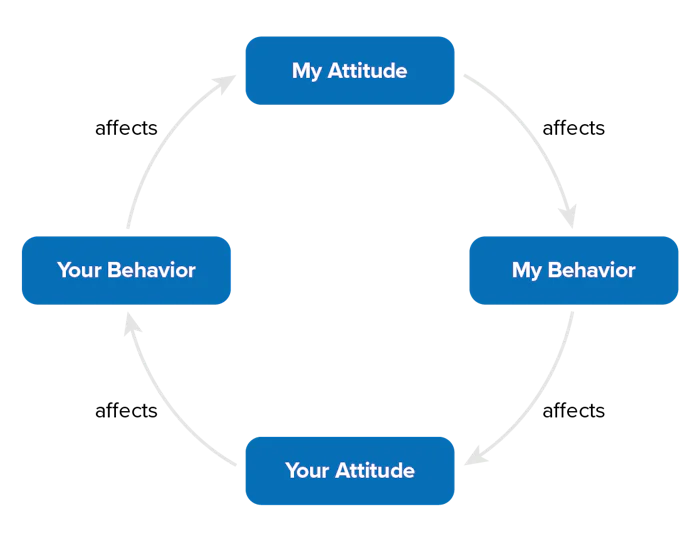
The Betari Box, seen in figure 1, is a simple model that can help us to understand the impact that our attitudes and behaviors have on the attitudes and behaviors of the people around us.
Figure 1: The Betari Box Model
Our frame of mind plays a large role in the behavior we exhibit. When we're feeling motivated and positive, we smile, we compliment our team, and we empower those around us.
When we're feeling negative, the reverse is often true – we can be impatient, we get angry, we might even yell or argue, and we can demotivate people.
As these behaviors affect the people around us, they direct those negative behaviors back on us – and the conflict gets worse.
Although the idea of the Betari Box is quite simple, understanding it can help people to recognize when they're stuck in a negative cycle.
Note:
It's not clear who originated the Betari Box, or where the name comes from. However, there is a village named Betari in Iran. If you know the origin of the model, please contact us!
How to Break the Cycle of Conflict
- Remember that your attitude, good or bad, affects everyone around you.
- The next time you're in a negative mood, stop what you're doing. Take a few minutes to assess why you're feeling so negative. Negativity often begins with an insignificant event (like spilling coffee or getting stuck in traffic) and just gets worse from there. Consciously decide to break out of the cycle by focusing on something positive.
- If a colleague is stuck in a negative cycle, remember that you have a choice in how you respond. Just because that person is negative to you, doesn't mean that you have to be negative back.
- If a team member is persistently grumpy and rude, explore the reasons for that negativity with them. Consider talking about the Betari Box, and highlight the consequences of their behavior on team productivity and on their own quality of life.
- It's possible to get into a downward spiral when someone is grumpy with you. You get defensive and grumpy back, and so on. If this happens, see if you can agree to "press the reset button," and be pleasant to one another from then on.
- Practice empathy at work. Empathy can get you out of a negative cycle once you're in it.
Betari Box Examples
Using the Betari Box is all about recognizing negative cycles, and making a change within yourself to break out of them. The following examples show what can happen when you are – or are not – willing to make this change.
Example 1
Imagine that your drive to work is very stressful. The longer you sit in traffic, the more frustrated you become – and by the time you get to the office, you're in a negative mood.
Your attitude causes you to behave in inappropriate, negative ways. Your temper is short, so you yell at your assistant, and then shout at a co-worker when you discover a mistake in the report they just gave you.
Your negative behavior, in turn, distresses your assistant and your colleague. They are upset by your attitude and behavior, and they then repeat and reflect them in other negative ways.
Your assistant is sulky and unhelpful for the next few hours, and your colleague is sarcastic and resentful towards you as well. No real communication takes place.
Example 2
Imagine that it's just after lunch. You've had your negative drive into work, and you've already yelled at your assistant and your colleague.
As you sit at your desk angry, you realize that this all started with something incredibly silly: your drive into work. After thinking about this, you decide to exit the cycle. You begin by offering your assistant a genuine apology, which they accept with a smile.
You also apologize to your co-worker, and you offer to work with them on the report to improve it. They also welcome your apology, and thank you for being willing to help fix their mistake.
The end result: productive, meaningful communication can now take place, simply because you were willing to stop your negative thinking and step out of the destructive cycle.
Example 3
The next day, your commute is just as bad, but you use relaxation techniques in your car. And you make a real effort to be positive as you go into the office. You greet your assistant and your colleague warmly. They are pleasant back to you, and you all have a positive, enjoyable, productive day.
The Betari Box Infographic
See the Betari Box represented in our infographic.
a
Key Points
The Betari Box illustrates how our attitudes and behaviors directly affect the attitudes and behaviors of people around us.
When we're stuck in a negative cycle, then it's up to us to stop that cycle by changing our attitude.
This will positively impact those around us – and therefore break the cycle.
Originator unknown. Please advise us if you know who the originator is.