

- Content Hub
- Business Skills
- Business Ethics and Values
- Social Responsibility
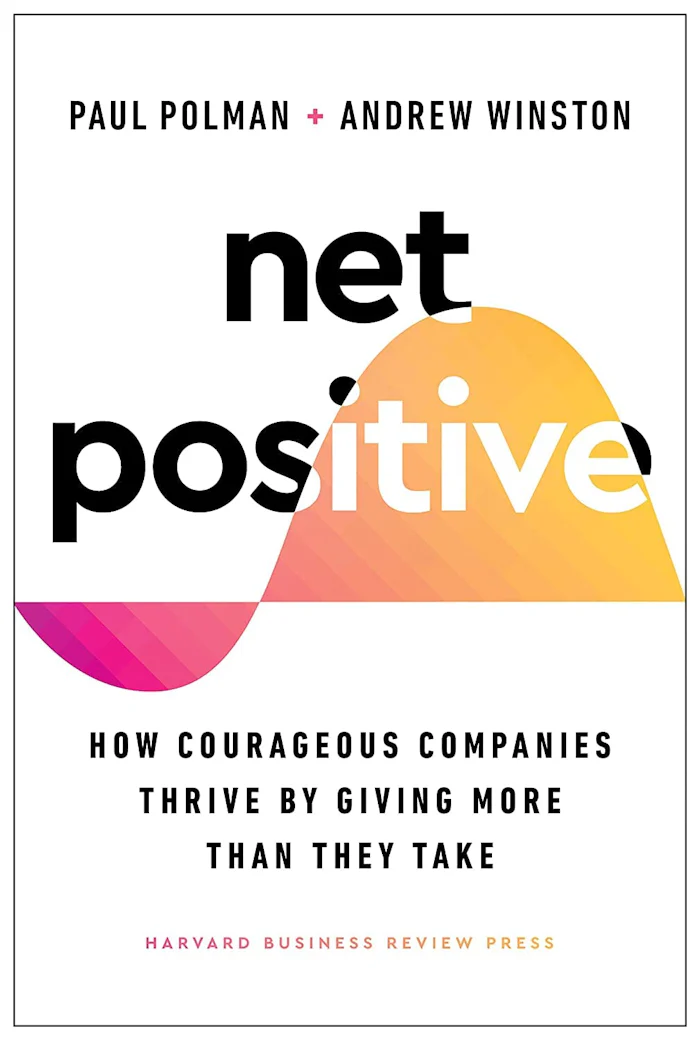
- Net Positive: How Courageous Companies Thrive by Giving More Than They Take
Net Positive: How Courageous Companies Thrive by Giving More Than They Take
by Our content team
Access the essential membership for Modern Managers
Transcript
Hello, I'm Frank Bonacquisti.
In this Book Insight, we're looking at "Net Positive: How Courageous Companies Thrive by Giving More Than They Take," by Paul Polman and Andrew Winston.
It's easy to be cynical about big businesses. Even when they seem to be doing the right thing, some people doubt their methods and motives. Is your energy supplier really planting a million trees a year to offset its massive carbon footprint? Will that even help? How does your favorite fashion store really treat its workers in the Far East?
Loudly proclaimed initiatives can turn out to be empty box-ticking exercises. Sure, big corporations like to be seen to be doing the right thing. It's good PR and keeps the customers onside. And increasingly, customers do seem to be making purchase decisions based on ethical considerations. For the world's biggest companies, there are plenty of ways around that.
But what if major corporations actually did change their operations, practices and culture to benefit humanity as a whole, rather than just their shareholders? What if they decided not just to do as little harm as possible to the environment, or their workers, but actually set out to improve things? To be net positive, as the title of this book has it.
"Net Positive" is a book about the cultural revolution within Unilever, the major global consumer goods corporation. It's also a roadmap for others to follow toward a world in which businesses actively seek to improve the wellbeing of customers, suppliers and primary producers – because it's good for business as well.
If you're a manager or leader in an organization, there's plenty to think about here, and plenty of practical advice. And if you're a general reader, maybe a little cynical about the ethics of big business, you may even find it uplifting.
Paul Polman was CEO of Unilever from 2009 to 2019. During his tenure, and since, he has helped to develop and promote the United Nations Global Goals on Sustainable Development. He was also the architect of the Unilever Sustainable Living Plan – you'll hear more about this later. And he's a venture capital investor in projects focused on sustainability, climate change and inequality.
Andrew Winston is an expert on global sustainability and corporate strategy. He's worked in consultancy, and has held management positions in strategy and marketing in the media industry. Educated at Princeton, Columbia and Yale, his previous books include "Green to Gold" and "The Big Pivot," highly regarded works on sustainability and ethical strategy.
So keep listening to hear more about how shareholders aren't as important as stakeholders, why palm oil is a bigger problem than you may think, and how to do good in the world while growing your business.
So what does net positive really mean? The subtitle of the book spells it out: "How Courageous Companies Thrive by Giving More Than They Take." At a first glance that doesn't seem like a great strategy. Businesses need to make more money than they pay out. That's basic economics. And if large, global businesses fail to make a lot more money than they spend, they're held accountable by their shareholders.
The problem is shareholders take a short-term view. If the quarterly numbers show healthy returns, they're usually happy. But this short-termism actually runs counter to the long-term health of the business, its suppliers and customers.
In order to make the right figures, a business will typically seek to drive production costs down. This squeezes suppliers, forcing them to cut their own costs. And the most effective way to do that is to pay their workers less and skimp on health and safety. So for the sake of a healthy investor dividend, whole communities can be driven into poverty and dangerous working conditions.
One of the earliest measures undertaken by Paul Polman as boss of Unilever was to stop quarterly reporting of results. This sent a clear message about his long-term vision for the company. It would no longer simply be accountable to its shareholders, but to everyone who had a stake in the success of the company and its products. Investors, suppliers and customers.
It was a bold move. The orthodox view in investment circles was that the shareholder was king, particularly when that shareholder also happened to be a financial institution or hedge fund.
For Unilever, the issue came into sharp focus when, in 2017, it faced a potential takeover bid by Kraft Heinz. By that point, Unilever's sustainability drive was in full swing and beginning to reap real business benefits. Kraft Heinz was a prestigious name in corporate circles, but had a reputation for prioritizing short-term success. It drove down costs, squeezed suppliers, and cut investment. Shareholders were delighted by their dividends. But the long-term health of Kraft Heinz's businesses suffered.
Unilever beat off the bid, largely by making the case to its own shareholders that sustainability was working. The company was not just doing good in the world; it was doing it profitably. And Unilever isn't alone. In 2020, 81 percent of sustainable businesses outperformed their market benchmarks.
But the shift in focus from short- to long-term is only part of the story.
"Net Positive" is divided into 10 chapters, and each deals with a different aspect of this transition to a long-term vision.
It begins with core principles. And a sense of purpose is critical in clarifying these principles.
What is the purpose of a global corporation? That can be hard to distill, particularly if the corporation owns multiple businesses selling everything from soap to stock cubes.
Unilever began by reconnecting with its history. Early in his tenure, Polman held a leadership team meeting in Port Sunlight, England. This was the model village set up by the Lever brothers, the founders of the company. It housed their workers in spacious, sanitary housing. They named it after their best-known product, Sunlight laundry soap.
This meeting reconnected the modern company's C-suite with the fundamental purpose of the business. What it had set out to do. The Lever brothers improved Victorian society by improving cleanliness through their products, and by offering their workers a decent standard of living. It was a symbolic starting point for a new chapter in the company's history.
Ideals and ideas are all well and good. But net-positive companies have to understand and take responsibility for how they materially affect the world. This broadens the meaning of a business in key areas.
For example, a net-positive business needs to optimize not just its own operations, but the experience of its suppliers and customers too. It needs to shift focus from financial shareholders to all stakeholders. This means everyone connected to the business. And it needs to understand that being connected to a large community of interest means seeking partnerships, not just acquisitions and mergers.
That's quite an in tray for any senior manager. So how do you lead in such a company? And how does the company make sure it's got the right people to lead?
The book suggests that leaders ask a challenging question: "What kind of world would we want if we did not know the circumstances we would be born into?" That calls for an imaginative leap. And it makes finding the answer a personal quest too.
The personal element is important for the net-positive vision. To promote engagement with the project, and cultivate a sense of responsibility and duty, employees need to have a clear sense of their own values and purpose. And that means as individuals, not just in their company roles.
So finding purpose and using it to boost performance is a big part of net-positive culture.
It's also a big part of Unilever's own codified strategy, the Unilever Sustainable Living Plan, or USLP for short. This was introduced in 2010, and set out to place purpose at the center of the business, driving an agenda that would benefit all the company's stakeholders over the long term.
To get the USLP moving, Unilever had to get its house in order. This meant eliminating unnecessary costs, and investing in people, brands, and innovation based on sustainability and long-term delivery.
It meant setting policies that drove net-positive thinking and behavior, with measurable goals. And it meant helping executives become authentic leaders, consistent in word and action. It was a huge agenda.
It soon became clear that Unilever needed to rethink the traditional boundaries within which it had always worked. It abolished quarterly reporting, reorganized its corporate structure, and made sustainability goals more important than strictly financial ones.
This process of rethinking brought some startling discoveries. Executives had spent years working on recyclable plastic packaging, but it was only by diving deep into the problem of plastic waste that Unilever discovered a shocking truth. Plastic recycling was a broken model. It didn't work. A redesign of the whole product-packaging model was needed.
The company removed rigid constraints on what it could work on, and who it could talk to. It gave its people space to think big, work for the long term, and invest in the future.
The project needed everyone in the company to buy into it. That required trust, and people habitually distrust change. So it's not surprising that the book has a whole chapter on building trust.
Unilever management started with transparency. They were open about what they were trying to accomplish. And they set out to work with all their stakeholders, inviting them in instead of waiting for them to knock on the door.
When entering new markets or partnerships, net-positive businesses start with what they can do for stakeholders, not themselves. They have to support stakeholder values, even when it's hard to do. Even when it brings the company into conflict with governments.
But not even a corporation as big as Unilever can change the world on its own. That requires the company to reach beyond itself. It means developing partnerships at industry level, with NGOs, and with governments.
Take the problem of palm oil. In Indonesia, palm oil plantations cover 16 million hectares of land. Most of that land was acquired by burning virgin rainforest. But palm oil production also provides a livelihood to millions of people who would be driven into poverty without it. So it's not as simple as replacing one ingredient with another.
By consulting with NGOs and organizations representing farmers, Unilever got to the core of the problem. To transition to more-sustainable practices, farmers need practical and financial help. There are oil-bearing species they can grow that cause much less environmental damage. But they take time to introduce, so farmers need interim help. And if they get that help, they will stop deforesting.
By taking responsibility for their impact on all parts of the process, Unilever is finding its way toward a workable solution. It treats suppliers as partners, not as low-cost providers, and builds trust and transparency with them.
Net-positive businesses also speak out collectively, leading commitments to large-scale action. Then they use their influence with peers to get others on board. With sufficient numbers joining in, they can negotiate with governments. And they need to know what to negotiate for.
Unilever is clear about the kind of climate policies it wants. Fossil fuels must give way to clean tech. Governments must invest in that technology, drawing in the private sector. Farming interests must reimagine land use, and drive down food waste. And if vulnerable people are disadvantaged by change, they must be supported and retrained to thrive in new circumstances.
Remember that caring for the environment is just one part of the USLP. It also focuses on huge issues of social responsibility, equality, and good governance. Its scope and ambition is vast. Net-positive companies, particularly large ones, need to think big. They have to be able to change not only industry practices, but government ones too.
This means engaging with policymakers before they write laws, and proposing solutions rather than waiting for regulation. It means being a trusted partner even when there's nothing directly in it for them.
But committing to address issues like climate change and racial inequality is only part of the story. There are plenty of problems that corporations, industries and even governments would like to see brushed under the carpet. These include tax avoidance, corruption, and overpaying executives. It's important for net-positive companies to take the lead on ethical standards, so they should pay their dues, openly and accountably. This helps to promote a culture of virtue, and likely leaves more money in the system to invest in stakeholders.
All these practical steps help to build a net-positive culture. This culture permeates all parts of a net-positive company, from leadership practice to company mindset.
Purpose comes to the fore in research, product development, marketing, finance, and so on. As the book says, it's a team sport.
So what do we think of "Net Positive?" Well, healthy skepticism is a good starting point. This is a book co-written by Unilever's former CEO. You'd expect it to take care of his reputation, and cast his former company in a glowing light. But it's no company brochure. Failures are acknowledged. Existing and future challenges are made as clear as resounding successes.
But overall, the signs are good. The book insists time and again that this is not simply a case of righteousness for the sake of it. It works. Making your suppliers and customers feel valued and listened to reaps significant bottom-line rewards.
Even so, there's still a mountain of work needed to make net-positive culture the norm, and challenge entrenched poor corporate practice. Here's where it's worth checking out the book's structure. It's written to be used. Every chapter has summaries of what net-positive companies need to do to change the world for the better. It also works as a call to action. If one of the world's biggest companies can reposition itself to emphasize the environment, equality, and good governance, then so can smaller, more-agile businesses. There's no excuse not to. And here's the blueprint.
"Net Positive: How Courageous Companies Thrive by Giving More Than They Take" is published by Harvard Business Review Press.
That's the end of this episode of Book Insights. Thanks for listening.


