Access the essential membership for Modern Managers
How does your organization create value?
How do you change business inputs into business outputs in such a way that they have a greater value than the original cost of creating those outputs?
This isn't just a dry question: it's a matter of fundamental importance to companies, because it addresses the economic logic of why the organization exists in the first place.
Manufacturing companies create value by acquiring raw materials and using them to produce something useful. Retailers bring together a range of products and present them in a way that's convenient to customers, sometimes supported by services such as fitting rooms or personal shopper advice.
And insurance companies offer policies to customers that are underwritten by larger re-insurance policies. Here, they're packaging these larger policies in a customer-friendly way, and distributing them to a mass audience.
The value that's created and captured by a company is the profit margin:
Value Created and Captured – Cost of Creating that Value = Margin
The more value an organization creates, the more profitable it is likely to be. And when you provide more value to your customers, you build competitive advantage.
Understanding how your company creates value, and looking for ways to add more value, are critical elements in developing a competitive strategy. Michael Porter discussed this in his influential 1985 book "Competitive Advantage," in which he first introduced the concept of the value chain.
A value chain is a set of activities that an organization carries out to create value for its customers. Porter proposed a general-purpose value chain that companies can use to examine all of their activities, and see how they're connected.
The way in which value chain activities are performed determines costs and affects profits, so this tool can help you understand the sources of value for your organization.
Elements in Porter's Value Chain
Rather than looking at departments or accounting cost types, Porter's Value Chain focuses on systems, and how inputs are changed into the outputs purchased by consumers.
Using this viewpoint, Porter described a chain of activities common to all businesses, and he divided them into primary and support activities, as shown below.
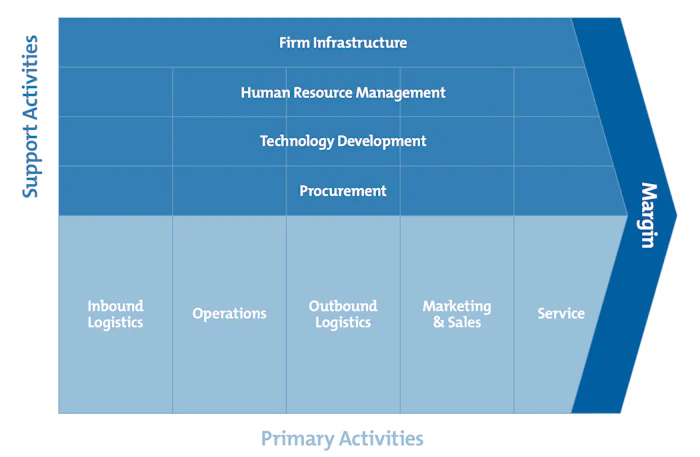
A well-maintained chain helps your business to run more smoothly.
Primary Activities
Primary activities relate directly to the physical creation, sale, maintenance and support of a product or service. They consist of the following:
- Inbound logistics. These are all the processes related to receiving, storing, and distributing inputs internally. Your supplier relationships are a key factor in creating value here.
- Operations. These are the transformation activities that change inputs into outputs that are sold to customers. Here, your operational systems create value.
- Outbound logistics. These activities deliver your product or service to your customer. These are things like collection, storage, and distribution systems, and they may be internal or external to your organization.
- Marketing and sales. These are the processes you use to persuade clients to purchase from you instead of your competitors. The benefits you offer, and how well you communicate them, are sources of value here.
- Service. These are the activities related to maintaining the value of your product or service to your customers, once it's been purchased.
Support Activities
These activities support the primary functions above. In our diagram, the dotted lines show that each support, or secondary, activity can play a role in each primary activity.
For example, procurement supports operations with certain activities, but it also supports marketing and sales with other activities.
- Procurement (purchasing). This is what the organization does to get the resources it needs to operate. This includes finding vendors and negotiating the best prices.
- Human resource management. This is how well a company recruits, hires, trains, motivates, rewards, and retains its workers. People are a significant source of value, so businesses can create a clear advantage with good HR practices.
- Technological development. These activities relate to managing and processing information, as well as protecting a company's knowledge base. Minimizing information technology costs, staying current with technological advances, and maintaining technical excellence are sources of value creation.
- Infrastructure. These are a company's support systems, and the functions that allow it to maintain daily operations. Accounting, legal, administrative, and general management are examples of necessary infrastructure that businesses can use to their advantage.
Companies use these primary and support activities as "building blocks" to create a valuable product or service.
Using Porter's Value Chain
To identify and understand your company's value chain, follow these steps.
Step 1 – Identify subactivities for each primary activity
For each primary activity, determine which specific subactivities create value. There are three different types of subactivities:
- Direct activities create value by themselves. For example, in a book publisher's marketing and sales activity, direct subactivities include making sales calls to bookstores, advertising, and selling online.
- Indirect activities allow direct activities to run smoothly. For the book publisher's sales and marketing activity, indirect subactivities include managing the sales force and keeping customer records.
- Quality assurance activities ensure that direct and indirect activities meet the necessary standards. For the book publisher's sales and marketing activity, this might include proofreading and editing advertisements.
Step 2 – Identify subactivities for each support activity.
For each of the Human Resource Management, Technology Development and Procurement support activities, determine the subactivities that create value within each primary activity.
For example, consider how human resource management adds value to inbound logistics, operations, outbound logistics, and so on. As in Step 1, look for direct, indirect, and quality assurance subactivities.
Then identify the various value-creating subactivities in your company's infrastructure. These will generally be cross-functional in nature, rather than specific to each primary activity. Again, look for direct, indirect, and quality assurance activities.
Step 3 – Identify links
Find the connections between all of the value activities you've identified. This will take time, but the links are key to increasing competitive advantage from the value chain framework.
For example, there's a link between developing the sales force (an HR investment) and sales volumes. There's another link between order turnaround times, and service phone calls from frustrated customers waiting for deliveries.
Step 4 – Look for opportunities to increase value
Review each of the subactivities and links that you've identified, and think about how you can change or enhance it to maximize the value you offer to customers (customers of support activities can be internal as well as external).
Tip 1:
Your organization's value chain should reflect its overall generic business strategies. So, when deciding how to improve your value chain, be clear about whether you're trying to set yourself apart from your competitors or simply have a lower cost base.
Tip 2:
You'll inevitably end up with a huge list of changes. See our article on prioritization if you're struggling to choose the most important changes to make.
Tip 3:
This looks at the idea of a value chain from a broad, organizational viewpoint. Our separate article on value chain analysis takes a different look at this topic, and uses an approach that is also useful at a team or individual level. Click here to explore this.
Key Points
Porter's Value Chain is a useful strategic management tool.
It works by breaking an organization's activities down into strategically relevant pieces, so that you can see a fuller picture of the cost drivers and sources of differentiation, and then make changes appropriately.



