


Key Takeaways
- Many people respond defensively or dismissively to feedback, preventing meaningful personal or professional change.
- The Feedback Matrix helps individuals categorize feedback as positive or negative, and expected or unexpected, to better understand and apply it.
- Constructive use of expected feedback involves reflecting on past efforts and identifying actionable steps for improvement or growth.
- Unexpected feedback – both positive and negative – can reveal hidden strengths or blind spots, offering valuable opportunities for self-discovery.
- Managers can use the Feedback Matrix collaboratively with their teams to foster more productive conversations and drive behavioral change.
As a manager, how often do you give your team members feedback on their performance, only to find that nothing changes as a result? You think you've made your points clearly and directly, but sometimes people just don't seem to get the message.
Or, perhaps you've received feedback from your own manager but felt unsure about how to act on it?
The Feedback Matrix* is a tool that encourages you to examine both the positive and negative aspects of feedback. It challenges you to connect the comments to what you already know about yourself, and to what you did not know and need to explore more fully.
In this article, we examine a range of typical responses to feedback, and we look at how to use the Feedback Matrix to see beyond these patterns of behavior, and to make positive changes in yourself and your team that lead to improved productivity and better relationships.

Access the essential membership for Modern Managers
How Do You Respond to Feedback?
Maybe you've observed that people (possibly yourself!) react in one of these four ways when receiving feedback:
- They accept the negative part of the feedback, but try to explain it, justify it, or blame others for the problem. They may find it difficult to handle criticism, or are reluctant to be held accountable for their actions.
- They focus on the positive part, and use it to reinforce what they already know to be true. This reaction may indicate a resistance to change or poor listening skills.
- If the feedback is negative, they decide that the person giving the feedback is wrong and dismiss the comments entirely. These people can be prone to arrogance or over-confidence.
- If the feedback is completely positive, they assume that the person giving it is "just saying that" or being polite, and they can't accept that the praise is genuine. This may be due to a lack of self-confidence or self-esteem, or feelings of self-doubt.
In each case, the response means that the feedback will likely fail to achieve the desired result. Rather than trying to understand how their behavior or performance needs to change or what they can do to build on their strengths, people continue to do what they were doing before, without making any major adjustment or correction.
Using the Feedback Matrix
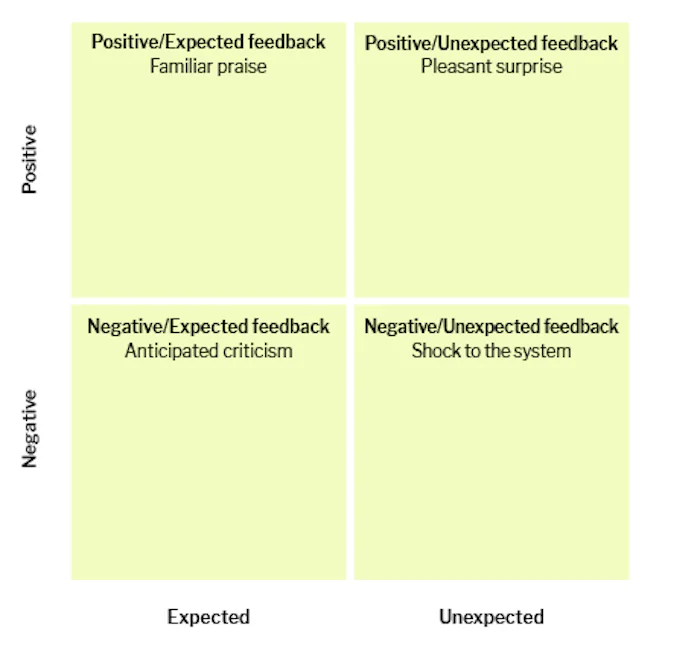
The Feedback Matrix is a tool for overcoming your emotional responses to feedback, so that you can apply it and make positive changes to your performance or behavior. As shown in figure 1 below, it has four quadrants that refer to the different types of feedback you receive. These are: Positive/Expected, Positive/Unexpected, Negative/Expected, and Negative/Unexpected. Most feedback falls into one of these categories.
Access the essential membership for Modern Managers
Figure 1: The Feedback Matrix
Let's take a closer look at each quadrant.
- Positive/Expected: we often have a good idea of what we do well, because we tend to receive positive feedback about these things regularly. But instead of simply hearing this familiar praise and doing nothing with it, ask yourself:
- How can I celebrate this aspect of myself?
- How can I use this skill to increase my productivity or job satisfaction?
- How can I use this skill to help others who are not as strong in this area?
- Positive/Unexpected: receiving positive feedback that we weren't expecting is like a surprise birthday present. It gives us a wonderful feeling when we learn something positive about ourselves that was totally unexpected.
But after the initial joy, it's important to examine this feedback further by asking yourself: - Why was I surprised to hear this?
- What previous experiences might have caused me to forget or dismiss this strength or ability?
- How will I celebrate this newly discovered skill?
- How can I use this skill to improve my life?
- Negative/Expected: if we're honest with ourselves, we're often aware of some of the areas in our work that need improvement. If our boss asks for a meeting, chances are we know and expect what will be discussed. In fact, we're often more critical of ourselves than others are, but we just don't know how to improve without some help.
To apply this expected feedback and make a positive change, ask yourself: - What actions have I already taken to address this concern?
- How successful were those actions?
- What else do I need to examine and/or change to achieve the results that I want?
- If I don't make these changes, how will this impact my job or life?
- Negative/Unexpected: this feedback is the most difficult to hear and understand. But it can also be the source of much self-discovery, if we're open to it. Unexpected feedback often comes from areas that we don't want to acknowledge, or aren't prepared to face, and it may cause us to become defensive or experience other strong emotions. However, when we learn to deal with it, we can take big steps forward on our journey of self-improvement.
Some further questions to explore include: - What other information do I need to make sense of the feedback?
- What support, training or coaching do I need to deal with the implications?
- Can I use this feedback to discover more about myself? Our article, The Johari Window, can help with this.
- What plan can I put in place to make small, achievable changes in the short term?
- How will improving this affect other areas of my job or life?
If you are a manager, you can also use the Matrix when you're giving feedback to your team members. You can discuss whether what you have said falls into its categories, and you can work through the questions together. Our article, The Five Conversations Framework, explores ways to have positive dialog in such situations.
Download our Feedback Matrix template to use the Matrix. When you give or receive feedback, use it to improve your experience – and your outcomes.
Tip:
The Situation – Behavior – Impact Feedback Tool is another way to provide clearer, more effective feedback, by emphasizing the ways that specific issues impact other people.
Access the essential membership for Modern Managers
Key Points
Feedback is meant to be the first step toward change. Unfortunately, your emotional reactions to feedback may hamper your ability to respond positively to it.
The Feedback Matrix helps you to see past these reactions and get the most from a feedback session. With it, you can examine the negative and positive aspects of the feedback, and ask yourself questions that will help you to make the most out of it.
The Matrix covers four types of feedback:
- Positive/Expected.
- Negative/Expected.
- Positive/Unexpected.
- Negative/Unexpected.
With the help of this tool, you can use feedback effectively to achieve significant, positive change.
* Originator unknown.
Thanks to Kathryn Jackson, a life coach and Mind Tools newsletter reader from New Zealand, for sharing this useful tool with us.
Share this post
Discover more content

Feedback Essentials
A basic overview of everything you need to know about the value of feedback.

Creating an Organisational Feedback Culture
A guide to introducing or expanding the use of feedback in your organisation.

The Situation-Behavior-Impact™ Feedback Tool
Use the Situation-Behavior-Impact (SBI) feedback model to give feedback that is focused, specific and objective.