

- Content Hub
- Leadership and Management
- Performance Management
- Performance Management Essentials
- Performance Management Overview

Access the essential membership for Modern Managers
How to achieve effective performance management is one of the most hotly debated areas of management thought. This is largely because employee performance is recognized as the cornerstone of organizational success. A well executed performance management framework can encourage the development of a high performance culture and provide a clear link between individual goals and organizational objectives.
This article outlines the evolution of contemporary performance management and examines some of its most influential models and concepts. It also considers the critical link between individual and organizational performance, and looks at how different performance management tools can be combined to create an effective performance management system.
What is Performance Management?
Performance management is of utmost importance to the modern organization. It not only provides purpose and meaning to individual jobs but also the means to ensure that the objectives and development of individuals are aligned with long-term organizational goals.A good definition of performance management is provided by Bach: [1]
'A cycle of integrated activities which ensures that a systematic link is established between the contribution of each employee and the overall performance of the organization.'
From Performance Appraisal to Performance Management
Many modern performance management tools and methodologies can be traced back to Frederick Taylor’s early work on scientific management, [2] and Peter Drucker’s management by objectives (MBO) concept. [3] In the 1980s, the annual performance appraisal exercise became increasingly popular, as did the trend for force-ranking employees into A, B or C players. Companies such as General Electric and Microsoft were fierce proponents of forced-ranking, which identifies high performing A players and removes poor performing C players. In recent years, performance management has become a cycle of activities that link personal goals to strategic objectives, linking each employee’s contribution to the organization’s success.
The Performance Management Cycle
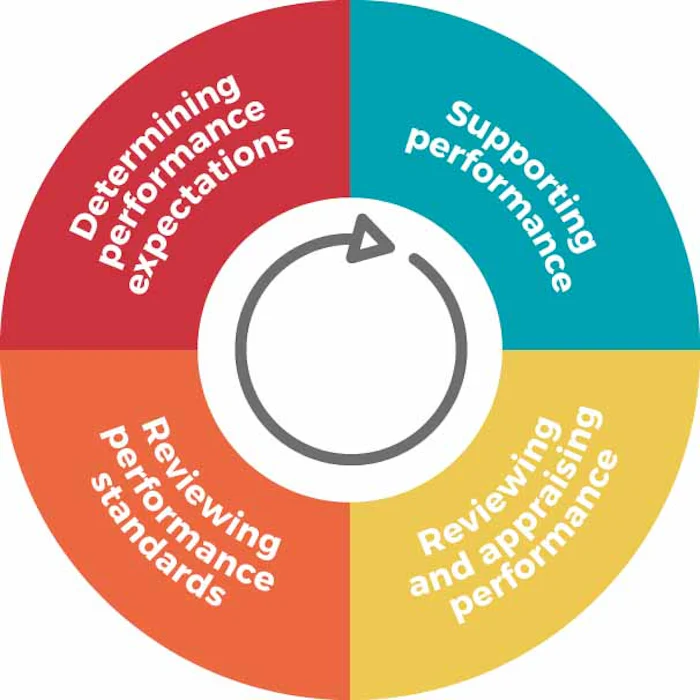
Many commentators argue that effective performance management cannot be achieved by a single system or technique (such as appraisal). Rather, it involves a strategic, continuous cycle of activity which combines a range of tools, policies and procedures. The consensus in performance management literature is that organizations should develop a bespoke approach which meets their needs rather than an ‘off-the-peg’ solution.The cyclical models proposed by Torrington and Hall, and Cave and Thomas provide a useful introduction to each component of the performance management cycle. These models argue that performance expectations should be determined at an early stage, followed up with regular support, review and appraisal of performance and finally re-assessment of performance expectations at the end of the cycle:
Jon Katzenbach’s 'five paths to high performance' model looks at how issues such as organizational context, culture and historical approach to performance can affect implementation of a performance management system. [4] This is an important consideration, as even a well designed system will not work if managers are not empowered and willing to deliver it effectively.
Aims of Performance Management
Armstrong and Baron state that the focus of performance management is to: [5]
- communicate a shared vision of organizational purpose and values
- define expectations of what people should deliver and how
- ensure that people understand what high performance is and how they can achieve it
- improve motivation and engagement by recognizing individual efforts and providing timely feedback
- enable greater ownership and responsibility for performance by allowing individual input to the formulation of objectives, self-monitoring of performance and self-assessment of what can be done to improve
Performance Management Problems
Despite the many benefits to be gained from its successful implementation, the search for an effective performance management system has been likened to the search for the Holy Grail. It presents an organization’s HR practitioners and managers with many problems, including:
- Increased complexity. Too often, organizations devise a performance management system that is far more complex than is required. This can lead to a lack of ownership of individual elements and an inability to deliver processes effectively. Many leading thinkers recommend testing and piloting systems in small areas of the organization before final implementation.
- Lack of senior management buy-in. The need for top management input is critical. However, too many top teams regard themselves as being ‘outside the system’. Many experts, including Kaplan and Norton, have found that successful performance management systems have made senior management involvement visible from the outset as a means of demonstrating the value of the system to the rest of the organization.
- Negative organizational culture. If the organization’s culture does not support the distinction between unacceptable and acceptable performance, then managers will be unlikely to devote the time and effort that is needed to deliver performance management processes effectively.
- Management unwillingness. Managers can often be unwilling to give their team members low performance scores, as this also indicates a problem with their own ability to deal with problems. Furthermore, some managers can ignore performance problems in the hope that they will be resolved without the need for intervention. However, failure to address performance issues at an early stage can result in more complex problems in the future.
Components of Performance Management
Organizations have many performance management tools at their disposal, including:
- Performance appraisal. A key aspect of the performance management system, appraisals assess and review individual achievement against a set of objectives. Formal appraisal meetings call for a specific suite of management skills including asking appropriate questions, listening, reducing personal bias and giving and receiving feedback.
- Setting and reviewing objectives. Objectives provide the critical ‘golden thread’ which connects individual contribution to organizational performance. [6] In an integrated performance management system, individual objectives should link to departmental, business unit and organizational objectives.
- Personal Development Plans (PDPs). A PDP is a tool which is normally used in conjunction with objective-setting to help individuals determine the actions that are required in order to address development needs and performance issues. Normally agreed with their manager, a PDP should be a living document which provides an appropriate timescale for development of an individual’s skills.
- Self and peer appraisal. Self appraisal can complement other forms of performance assessment, as it encourages individuals to reflect on past performance, compare their views with their manager’s views, and foster a sense of ownership of the performance review process. Peer appraisal gathers feedback for an individual from colleagues who are employed in a similar role or level of responsibility. This gives a multiple perspective of performance, and often works well in team environments.
- 180 and 360 degree feedback. The adoption of multiple sources of feedback is an important aspect of modern performance management practice. 360 degree feedback involves gathering comments from a number of stakeholders including external customers, team members, peers and superiors. Similarly, 180 degree feedback incorporates responses from peers and superiors. When implemented effectively, these models provide a more rounded picture of individual performance.
- Competency based assessment. The popularity of competency-based performance has increased due to the perceived fairness of an individual’s whole effort and ability being recognized across a range of job-specific competencies. Many organizations are now moving towards a combined model that acknowledges skills and competencies.
- Balanced scorecard. Developed by Kaplan and Norton, this framework suggests that organizations should establish objective indicators of performance from four perspectives:
- Financial: how do we appear to our shareholders?
- Customer: how do we appear to our customers?
- Internal: what business processes must we excel at?
- Innovation: how can we continue to learn and grow?
Individual, team and department objectives can be tied to the organization’s overall scorecard, thus providing a means of monitoring and assessing progress towards overall goals.
- Performance ratings. Although popular due to the consistency they provide across different business functions and departments, ratings are one of the most contentious issues in performance management practice. A performance rating system evaluates employees against a set of criteria based on whether they are better, equal or worse than their peers. Critics point out many problems with this approach, as it can demotivate staff and jeopardize the forward-looking and developmental focus of the performance review process.
- Performance-Related Pay (PRP). A number of performance based pay models are in use, including team based, individual and competency based pay. When executed correctly, PRP offers many benefits, but it is not without its critics. Many argue that performance and pay systems should be separate, and that PRP should only be used to motivate people under specific circumstances. [7] Furthermore, setting suitable performance measures can be complex, with inappropriate behaviors often being incentivised e.g. focusing on number of sales rather than customer satisfaction.
Tackling Poor Performance
Tackling poor performance is a key element of the performance management framework. Whether caused by illness, poor motivation, a lack of the right skills or personality clashes with colleagues, addressing absence and capability issues is something that many organizations and managers find problematic.
An integrated approach to absence management is important, therefore developing an organization-wide approach to absence control and measurement is a key step. Taking a holistic approach will provide a picture of current absence across the organization, and inform development of appropriate absence and capability policies. Supporting managers to deliver front-line absence and capability policies effectively is also important. The effective management of poor performance calls for the ability to:
- spot the signs of underperformance or misconduct at an early stage
- take early informal action (e.g. conversations and meetings where appropriate) to communicate performance expectations
- provide necessary support (e.g. coaching, training opportunities) to help individuals improve their performance
- move to formal processes (where appropriate) and address underlying issues quickly and with confidence
- understand why employees can become demotivated and how to encourage improvements
Conclusion
Performance management is vital to the success of all organizations, regardless of their size, industry sector or internal culture. Each organization should design a performance management system to suit its specific needs. Above all, the approach should aim to align strategic, department and individual objectives. Furthermore, performance management should be as simple as possible, command visible involvement from senior management and be implemented consistently across the organization.


