

- Content Hub
- Business Skills
- Project Management
- Project Risks, Troubleshooting and Review
- Sprint Retrospectives in Agile Project Management

Access the essential membership for Modern Managers
We all learn from experience. But, when you're under pressure to deliver quick results, it can be all too easy to forget what you've learned as you rush headlong into the next phase of your project.
Or, perhaps your team evaluates its performance regularly, but then falls straight back into long-established routines without questioning how these could be improved.
When you're managing an Agile project, it's important to learn from each cycle of activity, so that you can do things better in the next cycle. Sprint retrospectives enable you to do that. They allow you to step back after each stage of a project and reflect on what you have learned, what could be done better, and how you can apply those lessons in the future.
Evaluating projects in phases can help to continuously develop and improve performance.
In this article, we look at what sprint retrospectives are, we set out a five-step process for holding successful retrospectives, and we explore five different types of sprint retrospective.
What Are Sprint Retrospectives?
Sprint retrospectives are a feature of Agile Project Management. Agile is a flexible, collaborative, team-based approach that emphasizes the delivery of usable results from short bursts of activity, known as "sprints" or "iterations."
It is most often found in fast-moving business environments such as software development, where it's crucial to be able to respond quickly to customers' needs. But you can apply it to any sector that requires continuous improvement to processes and swift responses to changing customer expectations.
Typically, a sprint lasts two weeks and, at the end of it, the team examines its performance, discussing how it could have handled things better and how it could improve processes. These meetings are called sprint retrospectives, and they help Agile teams to maximize their learning and productivity.
You can consider sprint retrospectives as "beefed up" versions of another popular feature of Agile project management: the Scrum meeting. [1] These are brief, daily get-togethers, where team members discuss what they accomplished the previous day and what they'll be working on that day, and where the Scrum Master shares any new information about the project.
Tip:
Scrum teams usually follow Amazon CEO Jeff Bezos' "two-pizza rule." This states that the most productive teams have no more than nine members – the number you can feed with two large pizzas!
How to Run a Sprint Retrospective
In their 2006 book, Agile Retrospectives: Making Good Teams Great, Agile experts Esther Derby and Diana Larsen outline a five-step structure for a successful project retrospective:
- Set the stage.
- Gather data.
- Generate insights.
- Decide what to do.
- Close the retrospective. [2]
In figure 1, below, the right hand side of the diagram represents the retrospective. It shows how, once a sprint is completed (the left hand loop), you flow straight into the retrospective, and then the retrospective's findings and decisions flow into the next sprint. The goal is to continually improve the process.
Figure 1: 5 Phases of a Sprint Project Retrospective
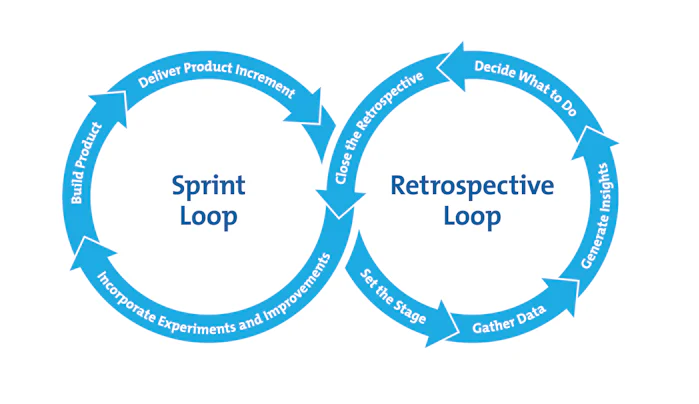
Adapted from "Agile Retrospectives: Making Good Teams Great," by Esther Derby and Diana Larsen, published by The Pragmatic Bookshelf. Reproduced with permission. Visit www.pragprog.com for more titles on Agile methods, programming, management, and creativity.
For example, let's imagine that you are the Scrum Master in a team of eight. In your latest sprint, you completed only three of the five deliverables that you had committed to, and you want to find out why. Let's see how you might conduct a sprint retrospective using Derby and Larsen's five-step approach:
1. Set the Stage
First, you welcome your team members to the meeting, tell them how long it will last, and state its goals and aims.
Next, you explain how you want to approach the discussion. The aim is to find out why the team didn't deliver everything it had expected to, and to identify how things could be done better in the future. It is not a meeting to attribute blame or pass judgment, and you encourage all your people to participate fully and speak freely.
Ask team members to give one-word summaries of their thoughts or feelings about the sprint. You can write these on a whiteboard, or put them on sticky notes. This exercise will give you an immediate insight into the issues that are most important to the team.
2. Gather Data
Now, examine the events of the sprint. Pay attention to facts and figures, but also identify any areas of frustration and how the team felt during the sprint. Look closely at your team's processes: go through the details of what should have been delivered, and what actually was delivered. Discuss what may have happened that slowed the team down, or prevented it from achieving its objectives.
In our example, your team members admit to feeling pressurized during the last sprint, and say that they were confused at the outset about exactly what was required of them.
3. Generate Insights
When you've analyzed the data, think about what did and didn't work, and why. Try using a technique such as Five Whys if you struggle to identify the causes of any problems. Write down all the ideas on a whiteboard or sticky notes.
Also, don't ignore the successes that you enjoyed in the sprint. If something worked well once, it may do so again.
In our example, the team acknowledges that it completed three of five deliverables on time and to a high standard. But it identifies a blockage in receiving information from other departments, which led to a series of frustrating false starts. The confusion and wasted time caused by these false starts prevented the remaining two deliverables from being completed.
4. Decide What to Do
Look at the insights that you've noted down, and discuss which ones are the most important to the success of your project or to your next sprint. Choose one or two to develop into an action plan. Assign specific actions to particular individuals, so that the team knows who is responsible for seeing them through.
In our example, the team decides that the information blockage was the biggest impediment to progress during the last sprint. You resolve to address the issue with the departments concerned, and take responsibility for improving communication for the next sprint. Your team members agree to flag up any repeat of the problem straight away.
5. Close the Retrospective
Recap everything you've discussed in the retrospective, and document it for future reference. You can discuss the progress of the measures that you have introduced at the next retrospective, along with any new issues that have arisen.
To close, ask your team members for their thoughts on the retrospective, focusing on its productivity and whether there's anything you could do differently next time. Finally, thank them for their time and their hard work during the last sprint.
Are Sprint Retrospectives Right For You?
Sprint retrospectives are designed to work with Agile methodology. So, if you don't use Agile, they may not be best for your situation.
For example, in manufacturing, it can be very costly to make changes during a big production run. In this case, a large-scale Post-Implementation Review may be a more suitable way to assess your work, as it takes place only after the whole project is complete.
Like sprint retrospectives, After Action Reviews allow you to evaluate your performance as you go along. They don't have to be part of an Agile process, though. They tend to be triggered by specific events or milestones, and they can be tied to specific events rather than projects.
Five Formats For Effective Sprint Retrospectives
You don't have to run your sprint retrospective in the same way every time. Varying your approach can help to keep the discussion fresh and interesting for your team. You may also find that some formats address particular issues better than others. Feel free to experiment with formats and adapt them to fit your own needs.
Here are five formats to get you started:
1. Car Brand
This format gives you a quick insight into how each team member feels about the completed sprint, and can highlight areas that need improvement.
Simply ask your team members, "If this stage of the project was a car brand, which brand would it be?" The happier they are, the more prestigious or "sporty" the brand they will likely name.
Use the answers as a starting point for your discussion. Invite people to consider what changes they would make to the next phase of the project to transform it into their "dream car."
But it needn't be a car brand. This exercise works equally well with fashion labels, movies or anything that feels appropriate for your team.
2. Stop, Start, Continue
This format is fast and focuses on quick wins. The aim is to find out what your team members think they should stop doing, start doing, and continue to do as part of their working process.
Write the three headings – Stop, Start and Continue – on a whiteboard or flipchart. Then ask people to consider questions such as:
- "What should we start to do, that we haven't done before?"
- "What is inefficient, or wasting time, that we should stop doing immediately?"
- "What's working well, that we should keep on doing?"
Give the team 10 minutes to write down its answers on sticky notes, and then place the notes under the relevant heading. Group similar answers together. Discuss or vote on which points to take action on.
Keep the notes, so that you can refer to them at the next retrospective and assess the impact of your actions.
3. Hot Air Balloon
This exercise requires some simple drawing skills, so feel free to let the best artist on your team use the pen! It's a simple exercise to identify which processes work efficiently, and what blocks your progress.
Draw on a whiteboard a large hot air balloon with a basket underneath. Ask your people to think about the sprint in terms of "flames" and "sandbags." Flames are events or issues during the sprint that have "lifted them up," and sandbags are things that have "dragged them down."
Get team members to write their answers on sticky notes, then stick the "flame" notes on the balloon and the "sandbag" notes around the basket. Group similar ideas together, discuss which ones are the most important to the team, and decide where you should take action.
You can repeat the exercise by adding a sun and a storm cloud to the picture, and brainstorming what will likely happen in the next sprint. What challenges could you face that would make it stormy? And what could you do to steer toward the sunny day?
4. The Waste Snake
The Waste Snake is an exercise that you can do throughout the sprint, and which then provides a framework for discussion in the sprint retrospective.
At the start of your sprint, draw the head and tail of a snake, and attach them to the wall.
Then, for the duration of the sprint, team members add a sticky note to the snake's body every time their work is interrupted, or they are sidetracked by something that is a poor use of their time or resources. The note should include the affected team member's initials, a brief description of the wasteful activity, and the approximate time spent on it.
The goal is to eliminate as many of these time-wasting factors as possible. In the sprint retrospective, review the notes and discuss how you can avoid them in the next sprint.
5. Questions Retrospective
In this format, the Scrum Master poses a series of questions to the team. A good place to start is with the four key questions identified by Norman Kerth, in his influential 2001 book, Project Retrospectives: A Handbook for Team Reviews. They are as follows:
- "What did we do well, that if we don't discuss we might forget?"
- "What did we learn?"
- "What should we do differently next time?"
- "What still puzzles us?" [3]
Used by permission of Dorset House Publishing from Norman L. Kerth, 'Project Retrospectives: A Handbook for Team Reviews,' copyright © 2001, ISBN 978-0-932633-44-6; www.dorsethouse.com. All rights reserved.
In their 2013 book, Getting Value Out of Agile Retrospectives: A Toolbox of Retrospective Exercises, Luís Gonçalves and Ben Linders offer further suggestions for questions, including:
- "What helps you to be successful as a team?"
- "How did you do it?"
- "What is your biggest impediment?"
- "What causes the problems you had in this iteration?"
- "What do you need from people outside the team to solve these problems?" [4]
Used by permission of Ben Linders and InfoQ.
Choose your questions according to the issues that the team has faced during the sprint. Use the answers as a framework for discussing the sprint. Keep your notes and refer back to them in the next sprint, to check that the issues raised have been addressed successfully.
Key Points
Sprint retrospectives allow you to step back and reflect on what you've achieved, what went wrong, and how you can do better in the future. As a result, they can improve team learning, productivity and job satisfaction.
Agile project retrospectives often have this five-step structure:
- Set the stage.
- Gather data.
- Generate insights.
- Decide what to do.
- Close the retrospective.
Successful Agile retrospectives avoid negativity and blame, and encourage honesty and open debate. The skill of the retrospective leader is key to keeping the session positive and focused on its goal.


