


Access the essential membership for Modern Managers
Transcript
Welcome to the latest episode of Book Insights from Mind Tools.
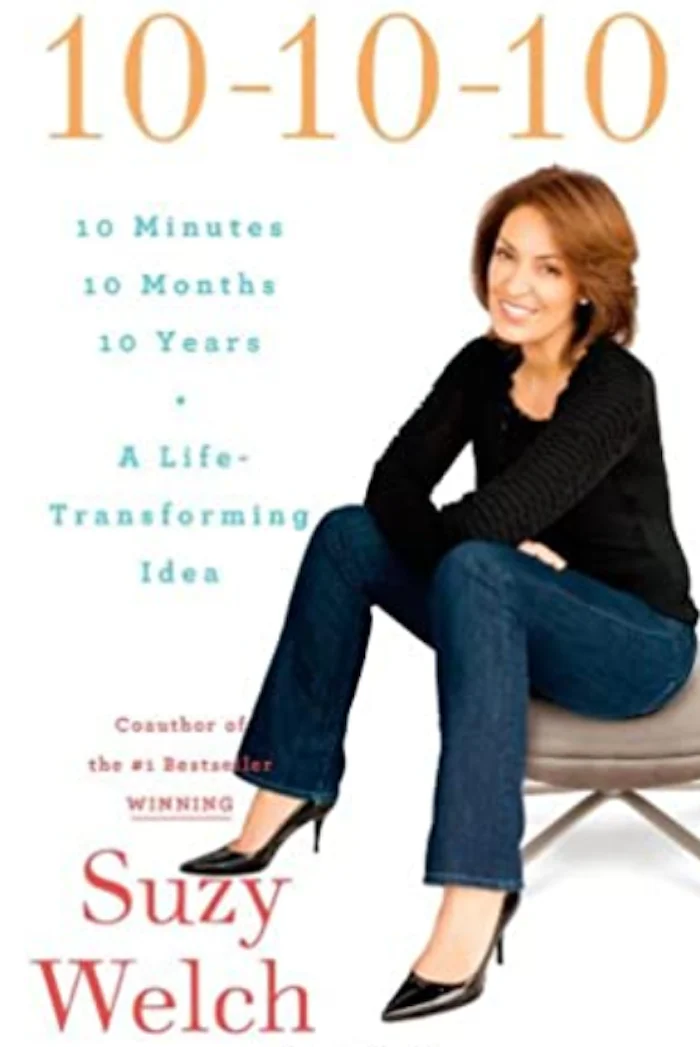
In today's podcast, we're looking at "10-10-10: A Life-Transforming Idea" by noted journalist, author, and public speaker Suzy Welch.
Now, this may strike you as an ambitious title, but you may not think so by the end of the book.
In "10-10-10," the author aims to give her readers a simple decision-making formula to help them take control of their lives and make choices free from chaos, confusion, and guilt.
10-10-10 stands for 10 minutes, 10 months, and 10 years, and the book aims to show the positive results that come from making decisions proactively, by considering the impact of various options in the immediate present, the near future, and the distant future.
To demonstrate the process in action, the author interweaves the theory behind "10-10-10" with a series of touching stories from her own life experience and from the lives of others who've used this technique to positive effect.
So who's this book for? Well, if you feel your life is unmanageable and you find yourself constantly putting out fires, this book could help you take control. Or if you make decisions solely on your gut instinct and often land in a mess, you may also find this book useful.
But you don't have to be in a crisis to enjoy "10-10-10" or to learn from it. Company directors who want to make clearer decisions will benefit, as will students choosing their first careers, or single men or women looking for a partner.
In a world in which we're constantly bombarded with choices, "10-10-10" offers valuable advice for just about everybody.
Now, the premise is so simple that you may read the book's introduction and first chapter and wonder whether you really need to finish the remaining 196 pages. What more could there be to say? But the author goes on to examine the science and psychology behind decision-making, to pose probing questions about our values, and to show, with the help of countless real-life stories, how readers can use 10-10-10 to make crunch decisions in their romantic relationships and their family lives, and in their careers.
The author's experience as a journalist certainly lends itself to this combination of theory and story telling. Suzy Welch writes a work-life column for O. The Oprah Magazine and used to be editor of the Harvard Business Review. She also co-authored the number-one bestseller Winning with her husband Jack Welch, former CEO of General Electric.
But it's perhaps her life experience that most qualifies her to write about difficult choices. Married, divorced and remarried, the author has four children and knows all about juggling motherhood with a successful, demanding career. She recounts her personal ups and downs with humor and humility, making 10-10-10 a lively and accessible read.
So keep listening to hear how one woman used 10-10-10 to navigate a crisis with a drug-addicted child, how another used it to prioritize a family holiday over an important work commitment, and how the author leaned on 10-10-10 to choose divorce over an unsatisfactory marriage.
The author starts off by telling readers how she came up with this decision-making technique.
It was 1996 and she was juggling a full-time job at the Harvard Business Review with the demands of four children under six. And her marriage was on rocky ground.
Enticed by the kudos and a high fee, she agreed to speak at a convention of business executives in Hawaii. But she decided she couldn't leave all four kids with her husband, so she chose to take two along with her.
What follows is a tale that would make any working mother or father cringe. Bleary-eyed after a sleepless night with her kids, she packed them off to a hula-dancing camp on the beach and donned her power suit for the conference.
As she neared the end of her presentation, her five- and six-year-old son and daughter burst into the back of the auditorium, complete with hula skirts, causing many a raised eyebrow among the somber audience.
Despite her embarrassment, the author stubbornly struggled through another 24 hours of trying to be a competent mother and a brilliant career woman. She collapsed into a chair at dawn on the balcony of her hotel room, the balancing act finally over.
At that moment, the author decided that something had to give. She resolved she had to find a way to have a more ordered existence. As the sun came up over Hawaii, the concept of 10-10-10 was born.
The author goes on to show readers how to put 10-10-10 into practice to make faster, cleaner and sounder decisions.
The basic premise of the technique goes like this: Begin with a clearly defined question. Should I quit my job? Should I stay in this relationship or end it? Precision is key to be able to see the wood from the trees.
The next stage of the process involves information gathering. You ask yourself what will be the outcome of each of your options in ten minutes, ten months and ten years.
Obviously, 10-10-10 is just a guideline. What the author is talking about here is the "right now" versus the foreseeable future versus the long-term.
Now to the final, all-important stage: analysis. Here you take all the information you've gathered and compare it to your values – your beliefs, goals, needs and dreams. You ask yourself which decision will best help you create a life of your own making. Hopefully, you'll come up with an answer that will allow you to move forward with peace of mind – and with a means to defend your decision to those around you.
In Chapter Two, the author delves into the science and psychology behind decision-making. She explains how the human default setting is something known as "hyperbolic discounting". This means we act as if the future doesn't exist, so we tend to choose smaller, immediate rewards over a more valuable pay-off in the distant future. Or in simpler terms, 'Eat, drink and be merry for tomorrow we may die.'
Here, the author discusses that familiar notion of "gut instinct". Now you may be wondering what's wrong with this tried and tested formula. Well, the author says our gut instinct can be good but it's also inadequate. It can be skewed by stress, time pressure, and adrenalin, or driven off course by the ingrained responses we've acquired over our lives.
The author argues that our gut simply isn't trustworthy enough for life's big calls.
Chapter Three focuses on values and how we can use 10-10-10 to bring our lives into line with our deepest beliefs and dreams.
Do you want to climb the career ladder, increase your salary and buy a bigger house? Or do you want to put your children to bed every night and watch their softball games? Maybe you want both, but something's got to give.
Here, the author poses a series of probing questions to help readers discover what their values are, whether they're their own or their parents' or grandparents', and whether they actually live by them.
In the remaining chapters, the author takes the reader on a journey through the world of love, work, parenting and friendship, using experiences from her own life and from the lives of 10-10-10 aficionados who've shared their stories with her.
So let's take a look at some of these stories to see if the 10-10-10 process stacks up.
One of the book's key themes is parenting, something the author has more than her fair share of experience of. The author argues that 10-10-10 is an antidote to that familiar feeling of parental guilt.
Here we meet Ana, who's married to Gary. They have three children and live in Detroit. Ana turned to 10-10-10 to make one of the toughest choices of her life.
At the time, her 17-year-old son Bobby was a drug addict who had dropped out of school. He would come and go at the family home, causing havoc every time, stealing money or getting into fights with his eight-year-old brother, Brian.
Bobby's behavior, and his parents' constant arguing about him, were affecting Brian and his eleven-year-old sister, Kara. Kara began struggling at school and Brian withdrew into video games. They both dragged their mattresses down to the basement to escape their parents' fighting.
Ana was determined to save Bobby and repeatedly welcome him home over the years, despite the pain he caused. But her husband wanted to disown him. Eventually, Gary said he would move out if Ana ever welcomed Bobby home again. Bobby was now 23.
Gripped by fear, Ana applied 10-10-10 to her situation. She concluded that in the short-term her husband's departure would destroy her two younger children. In ten months, perhaps she and her husband could restore their relationship and build a family environment again in which their younger children would thrive. The ten-year outlook was painful. Bobby could be lost forever. But Ana realized she'd tried to save him so many times before and he could only really be saved by himself.
She agreed with her husband to shut Bobby out of the house.
The author gives an update on Ana's situation to show that, however difficult, Ana's decision helped save her marriage and her home life. Bobby is in a drug rehab unit after spending time in jail. Ana doesn't know whether he'll ever rejoin the family, but her other two children are thriving. Both have moved their mattresses back upstairs.
The author dedicates a large section of the book to the world of work. Now, we all know that work-life balance is a common buzz phrase these days, but the author suggests reframing this idea as work-life choices and using "10-10-10" to help make these choices.
We are introduced to Barbara, a West Coast retail executive. She was so busy concentrating on her career that the baby bug passed her by – until she hit 45. After failing to conceive, Barbara and her husband John adopted a little girl, and soon afterwards, Barbara got pregnant. In the following years, Barbara and John, a neurologist, juggled work and family life, but felt constantly exhausted. When the girls turned five and six, the couple decided they needed some good old family time and booked a trip to Disneyland.
Barbara gave her bosses six months' notice of her trip. But a week before they were due to go, Barbara's immediate boss, a woman of her own age, said the vacation had to wait, as the company CEO was coming to visit.
Barbara protested, but her boss said sacrifices were a necessary part of being a career woman. Barbara was stuck. She loved her work and was the main breadwinner in the family. She didn't want her career to suffer. But she also wanted to be part of her girls' lives.
Conducting a 10-10-10 analysis, she saw that staying or going in the short-term would leave her with a crisis, either at work or at home. In ten months, her boss may have backed off and forgotten Barbara's choice, but the girls could still be reeling from the disappointment. The ten-year scenario was the clincher. She decided that trust and intimacy with her daughters over the long-term was more important than being a rung higher at work. Disneyland won out.
Of course, Barbara felt pangs of guilt on returning to work after the trip, but she had 10-10-10 to help ease her conscience.
The book is packed with stories from 10-10-10 fans like Barbara, but some of the most fascinating tales come from the author's own experience.
The author explains how she used 10-10-10 to choose her son's karate junior black belt test over a great work opportunity. But another time, she used it to decide to stay late at work, rather than keep her promise to spend a fun night at home with her kids.
With great self-awareness, the author explains how she failed to use 10-10-10 when she first met Jack Welch and got involved with him, despite the fact that he was still married. She lost her job at the Harvard Business Review and was hounded by the media. She confesses she'd have done things differently if she'd used 10-10-10. Hindsight is a wonderful thing.
The author also walks us through her decision to divorce her first husband.
It was a spring weekend in 2000 and they were both on a hike with friends. The warm embrace of another couple prompted the author to examine her own unsatisfactory marriage. Sitting on top of a rock ledge, she conducted a 10-10-10 analysis of her married life.
Short term, she knew divorce would inflict pain on herself, her husband and especially her children. In ten months, things could be worse. There may be a raging divorce battle. But in ten years, she decided she could be living a real life of her own making, not one of deceit and pretence. And what kind of role model would she be for her children if she continued to live a lie?
She opted for divorce. The short-term repercussions were nowhere near as bad as she expected. The author explained her decision to her children using 10-10-10 and they understood. Her marriage may have ended eventually, the author concludes, but in ways she wouldn't have chosen.
That's just a small selection of stories about 10-10-10 in action, but there are many more. You'll read about friendships strengthened by 10-10-10 or brought to an end, businesses that were built up and careers changed.
Now, critical readers may question whether the technique is so simple that it's not worth writing a book about, or whether people could come up with the same answers without 10-10-10. Others may question the quality of the conclusions some of the people in the book arrived at using 10-10-10. And what about spontaneity? Well, the author does address this, saying 10-10-10 is not designed to stifle spontaneity and that we shouldn't always be guided by the long-term view.
One other thing about "10-10-10": While the book does include some stories about men, the majority of the examples come from the lives of women. This, combined with the author's own life experiences, gives the book a decidedly feminine feel that may not be right for all readers.
Most people, however, men and women, will be able to relate to the difficult choices described in the book. Readers who started out skeptical will more than likely end up feeling drawn to apply 10-10-10 to their own lives.
By providing so many real-life examples of 10-10-10 in action, the author makes a compelling case for its effectiveness. So, if you want to feel in control of your life rather than controlled by it, try giving 10-10-10 a go.
"10-10-10: A Life Transforming Idea" by Suzy Welch is published in paperback by Simon & Schuster.
That's the end of this episode of Book Insights.


