

- Content Hub
- Business Skills
- Strategy Tools
- Competitive Advantage
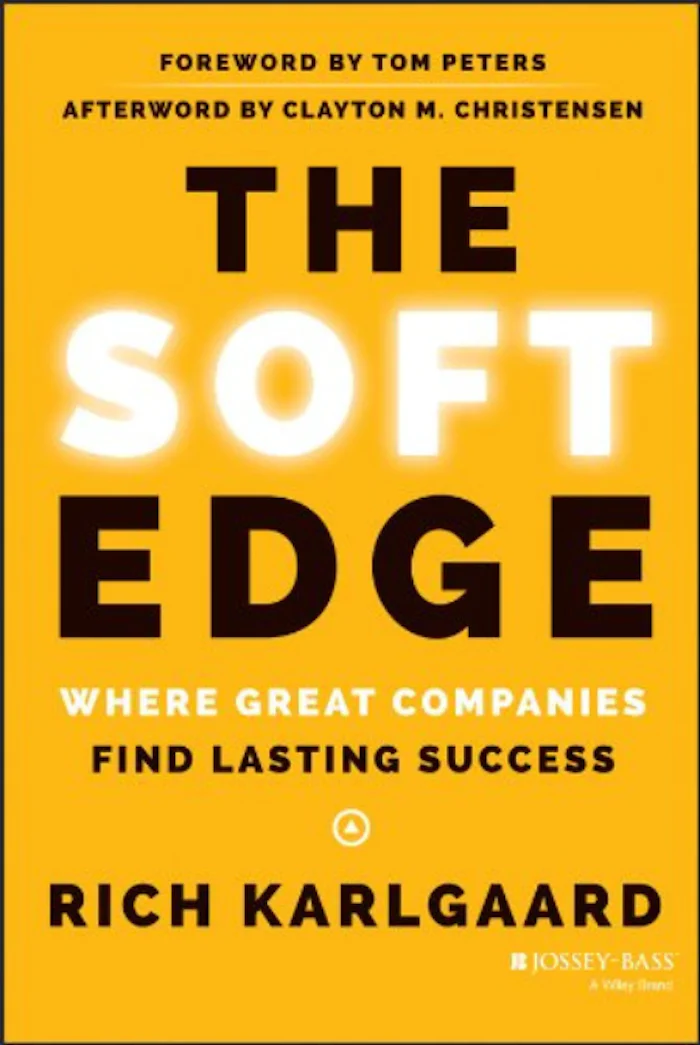
- The Soft Edge: Where Great Companies Find Lasting Success

Access the essential membership for Modern Managers
Transcript
Welcome to the latest episode of Book Insights from Mind Tools. I'm Frank Bonacquisti.
In today's podcast, lasting around 15 minutes, we're looking at "The Soft Edge: Where Great Companies Find Lasting Success," by Rich Karlgaard.
Take a moment to think about some big-name brands that have been around for a while and that look set to stay. What gives them their competitive edge? Is it a great leader, a sound strategy, incredible efficiency, or excellent execution?
Businesses need all these elements to perform well, but it's often something deeper and less tangible that makes truly great companies stand out.
Take Apple. It clearly has a sound strategy and execution, but it's the company's ability to win over people's hearts as well as their minds that's key to its success. Apple has mastered the concept of taste – it's found the perfect balance between functionality and deep emotional appeal, helping it build a level of brand loyalty that's matched by few others.
Taste is one of the elements that make up what this book calls the soft edge. This is where your organization's values lie and it can make all the difference to your success.
If you're trying to get ahead with technology, your rivals will soon catch up. If you think strategy and execution will set you apart, remember they can easily go wrong. And if you believe success is down to leadership, bear in mind that leaders come and go. But if you can build an organization around deep-seated values and leverage these values alongside solid performance in other areas, you could be around for the long haul.
If this sounds like an attractive proposition, you'll want to read this book. It explores how some of the world's leading companies have achieved long-lasting success by giving soft-edge skills or values the attention they deserve. And it shows readers how to do the same. It offers tips on building and running effective teams, creating an environment of trust, adapting quickly to new market realities, designing products that tug at people's heartstrings, and telling a compelling story.
So who's this book for? "The Soft Edge" has a really broad appeal, since the author features such a wide range of companies and individuals, including CEOs, financiers, sports coaches, and a chef. It's targeted primarily at leaders whose job it is to instill and promote an organization's values, but it's just as relevant to managers of small teams and those involved in product design, marketing, sales, or customer relations.
It's also a really engaging read and many of its lessons are equally applicable to non-profits and the self-employed, so don't be put off if you're not involved in big business.
The author, Rich Karlgaard, has spent three decades observing businesses, so his theories are well researched. He's the publisher of Forbes magazine, author of its "Innovation Rules" column, an entrepreneur, angel investor, and board director. He co-founded Upside magazine, Garage.com, and The Churchill Club, a Silicon Valley business forum with seven thousand five hundred members.
So keep listening to hear how to get your employees to trust you, how to stay ahead by embracing ideas from outside your industry, and how to design products with an emotional pull.
"The Soft Edge" is neatly structured and easy to read. The author starts out by explaining the difference between the soft edge and the hard edge of business.
Strategy and execution make up the hard edge and both are important. It's vital to have a sound strategy built around your market, customers, competitors, indirect competitors, and any potential game changers like big advances in technology. You also have to get the execution right, in terms of speed, cost, supply chain, logistics, and capital efficiency. But many businesses and business schools put the emphasis on the hard edge and neglect the more human, soft-edge values.
The rest of the book explores the five pillars of the soft edge – trust, smarts, teams, taste, and story. So let's look more closely at a few of these.
Trust comes first because it's the foundation of a successful company. Do your customers and shareholders trust you? And can you say the same of your employees and suppliers? You need the trust of your external and internal market to build an enduring business.
Northwestern Mutual has mastered the value of trust. It's a 157-year-old insurance and financial services firm based in Milwaukee, Wisconsin, with annual revenues of $25 billion. Its longevity, the fact it's owned by its customers, and its healthy balance sheet all help Northwestern Mutual maintain its trustworthy reputation. But how do its leaders build an environment of trust on the inside?
The author offers some good tips on building trust from this giant life insurer and other companies.
Trust begins at the top. Leaders must live and breathe a company's values. The author shares a story from the 1990s, when he spent a week on the road with Microsoft's Bill Gates who was marketing the latest version of Office.
On a late-night flight, the author asked Gates why he insisted on flying coach when he was worth billions. Gates replied that Microsoft paid for coach, Hiltons, and Ford rental cars, not first-class tickets, Four Seasons hotels, or Cadillacs. And if he didn't follow the company's cost guidelines, then nobody else would.
It's also important to show employees you trust them, so treat them like adults. Banning workers from accessing social networking sites like Facebook and Twitter may seem like a sensible, time-saving measure, but if this rule erodes trust and saps morale, productivity will suffer.
Similarly, trusting employees to get their work done whether they're in the office or at home, and allowing them to plan work around the school-run, will lead to a more contented and committed workforce.
Of course, some take a different view. Yahoo! CEO Marissa Mayer shelved her company's popular work-from-home policy, and it may not be suitable for all organizations.
Identifying your company's purpose will also help breed trust. Having financial goals is not enough. Do you have direction and meaning? What kind of value do you offer your employees, your customers, or society as a whole? The best sales reps at Northwestern Mutual are those who believe their work makes a difference to the families the company insures.
Finally, it's important to create an environment where information flows freely and where employees feel safe to speak up, question strategy, and make mistakes.
The author notes that there's nothing particularly new or surprising in this chapter on trust and we agree with him. We also agree that many organizations talk about values like trust, but when you look closely, they're nowhere to be seen.
But it's worth noting that if you're looking for truly innovative ideas, some of this book's chapters will disappoint. The author incorporates colorful and fascinating case studies from his own career, but he also builds on the work of other authors, so some of the suggestions he gives are well known.
We say "some" chapters may disappoint and not all, because we particularly like what the author has to say about smarts and taste. So let's take a closer look at these aspects of the soft edge.
In this context, "smarts" isn't about intelligence or grade point averages. In the tough world of business, smarts is about hard work, perseverance, and resilience. It's about grit, courage, and a can-do attitude. These old-fashioned concepts are too often overlooked in favor of degrees from prestigious business schools or high IQ scores.
The best employees, leaders, and organizations are those who've been through trials and tribulations, learned from their mistakes, put themselves in situations that demand boldness, and ingenuity, sought out mentors, learned from others, and embraced ideas from outside their industry.
In the chapter on smarts, we meet a range of leaders who fit these criteria, from a women's basketball coach to a successful restaurant owner. This makes it a lively read.
Again, you'll have heard some of the theories before, although this doesn't mean they're not worth repeating. For example, David Chang, chef and owner of the international restaurant chain Momofuku, explains how he allows his trainees to make their own mistakes rather than correcting them, before their dishes make it onto the menu or a customer's plate.
This makes for a much faster, more organic learning experience, Chang says. We have to wonder if this strategy has ever led to problems, but the author doesn't explore this.
Another aspect of smarts that's perhaps less talked about is the concept of lateral thinking – the idea of adapting great ideas from other areas. Chang embraces this in his cooking, importing food from around the world to his restaurants in New York, Toronto, and Sydney.
More surprisingly, The Mayo Clinic, one of the world's leading brands in healthcare, is borrowing best practice from amusement parks and hotel chains to stay ahead of the curve. Cutting-edge technologies – like super computers that diagnose patients and come up with the best treatment plan – are threatening to disrupt the healthcare industry. So Mayo knows it has to play to its strengths, which include its personal connection with patients. It's on a mission to create a really welcoming environment, and who better to learn from than Disney and Ritz-Carlton? Mayo runs programs in association with both companies to train its employees to be as welcoming and hospitable as possible and to put patients at ease.
We like this chapter on smarts because the range of companies and leaders adds great variety, but also because it offers tips that can be adapted and used by any organization.
The section on taste is another highlight, with a broad range of case studies, from Specialized Bicycles, to Apple, to Coca-Cola. So let's take a closer look at why taste is such a vital soft-edge value.
As you heard earlier, taste is about that all-important emotional connection with the consumer. Whether we're attracted to beautiful design or think a particular brand is cool, taste is a massive differentiator.
Taste has three key elements: function, form, and meaning. No matter how good a product looks, it's no good unless it works. Functionality is a threshold all organizations must meet before they begin to think about form and esthetics. But once you've nailed this, the game is on to create something fun, cool, pleasurable, and appealing to your target market.
Coca-Cola got it right when it changed the design of its diet drink. Originally called Tab and sold in a pink and white can, it didn't go down too well with men. So Coke launched Diet Coke, in a can with a unisex design. Then, many years later, it introduced Coke Zero in a black and red can that was primarily targeted at men. The company made it seem like an original product by changing the sweetener slightly, but really it was just Diet Coke or Tab packaged to appeal to young males. And it worked.
Meaning reflects the significance customers give to a product or the associations they make with it. A company's marketing strategy contributes to this, but products will mean different things to different people. Take the off-road vehicle Hummer. To some, it's the epitome of masculine ruggedness, a car that can go anywhere and tow almost anything. To others, it's the embodiment of masculine insecurity and the most wasteful vehicle ever made.
To explore taste further, the author takes a bicycle ride up the Old La Honda Road in Northern California, a hill with a 7.8 average gradient that cyclists like to use as an endurance and speed test. He beats the record for the climb by three minutes, which seems remarkable until he reveals he was riding the Turbo, a motorized bike made by the bicycle manufacturer Specialized.
Unlike other electric-assisted bikes, the Turbo isn't ugly. Its smart-phone battery technology and motor are so well hidden that a typical cyclist will take a while to realize it isn't a regular bike. In fact, the motor's so quiet and unobtrusive that it convinced the author his legs were responsible for that record-breaking time, not the electric-assisted bike.
Specialized managed to turn a simple bicycle into a product with an emotional pull, a bike that changed the way the cyclist felt. This happened because its designers were all keen cyclists and knew what they wanted the bike to feel and sound like. They brought that all-important human factor to the process.
Data and metrics are just as vital, of course. Specialized's top time trial bikes, for example, are tested in wind tunnels, modified, and tested again. A bike won't sell just because it's cool.
But what Specialized has managed to do is find the sweet spot between hard data and human emotions, between the head and the heart. This is a difficult balance to strike but we think it's one of the most important concepts in this book – and something Apple has clearly mastered too.
The chapters on smarts and taste will definitely get you thinking about how to leverage soft-edge values in your organization and we think they more than make up for the less original parts of the book.
It's worth bearing in mind that "The Soft Edge" is about companies that got it right – you won't find too many stories of when things went wrong. Some readers may think it lacks a dose of realism; others will like its positive and inspiring message.
The author writes with authority but he's also a great storyteller who has a friendly, engaging tone and who takes the reader on a journey with him. There's plenty of theory in this book, including from other writers and business leaders, but the case studies are colorful and the dialog really lively.
So if you want to learn how to build a long-lasting, successful organization and be entertained along the way, we think you'll get a lot from this book.
"The Soft Edge" by Rich Karlgaard is published by Jossey-Bass.
That's the end of this episode of Book Insights. Thanks for listening.


