Access the essential membership for Modern Managers
Have you ever interviewed a job candidate who claimed to be good at something, only to discover later that they had been exaggerating their skills? It probably left you confused. After all, why would they lie about such a thing when they would certainly be found out if hired?
Or perhaps you manage someone who doesn't improve, even after you demonstrate what should be done. Or you've discovered that a member of your team who is humble about their skills is actually super talented.
It turns out that these behaviors are all common quirks of human psychology, as described by the Dunning-Kruger effect. In this article, we'll explore how you can manage its impact in the workplace.
What is the Dunning-Kruger Effect?
The phrase "Dunning-Kruger effect" refers to the findings made by psychologists David Dunning and Justin Kruger in their 1999 study, "Unskilled and Unaware of It." In it, Dunning and Kruger compared participants' actual skill level with their perceived level. Their findings revealed one central truth: "It takes competence to judge competence."
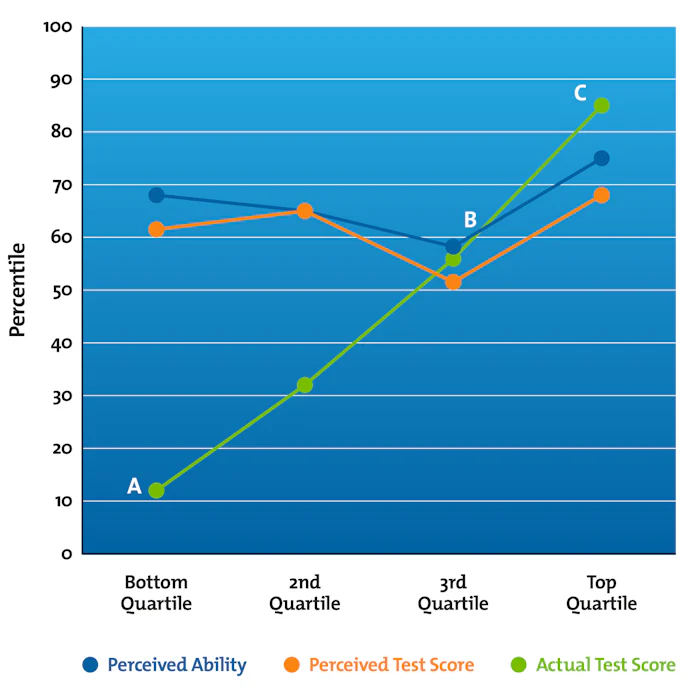
Figure 1, below, is a graphical representation of the Dunning-Kruger effect. It illustrates how good the study's participants thought they were at logical reasoning, compared with how highly they scored in a logical reasoning test.
Figure 1. Participants' Perceived Logical Reasoning Ability Compared With Their Actual Test Score
Diagram from "Unskilled and Unaware of It: How Difficulties in Recognizing One's Own Incompetence Lead to Inflated Self-Assessments," by Justin Kruger and David Dunning. Published with permission of the American Psychological Association Inc © Journal of Personality and Social Psychology, 1999.
The diagram shows that the least-competent test subjects (denoted at point A) actually rated their logical reasoning ability as "above average." This suggests that low-skilled people find it hard to assess their own skill level accurately and, as a result, tend to overestimate their ability.
In contrast, highly skilled people, at point C, were more likely to underestimate their own talents. Although, they were still more accurate in assessing their own abilities than lower-skilled participants were.
In general, the participants' perceived logical reasoning ability improved in line with their actual ability. And, where the lines meet at point B, people were able to make an accurate judgment of their own skill level. However, they were in the minority.
Applying the Theory in Your Workplace
The findings of Dunning and Kruger's study can be very useful in business, especially when you're recruiting and developing new team members.
They can, for instance, help you to understand why a particular team member keeps making the same mistake, and why he or she is unable to recognize it. They might also explain why some people seem inexplicably overconfident, and why brilliant people are often self-deprecating.
Use these six strategies to mitigate the Dunning-Kruger effect in your workplace:
1. Gather Your Own Data
If the quality of someone's work is poor, you, as his manager, will likely notice.
But, to make sure that your concerns over his work are fair and correct, try plotting your own Dunning-Kruger graph. Ask him how many tasks he thinks that he completes accurately and on time every month, and compare his answer with the real figure.
It can be easy to compile data for measurable competencies, such as technical skills, because every day is a test! But for competencies that are subjective – for instance, soft skills such as communication or negotiation – it can be much harder.
So, gather data from external sources, like impartial experts or clients, to get an accurate measure of more subjective skills. You could, for example, get a team member to rate his perceived customer service skill, and then compare this to customer feedback.
2. Address Any Skills Gaps
Team members that score low for the competencies that you test will likely be unable to recognize their own lack of skill.
It can be very difficult to explain to a member of your team that she is actually less competent than she believes herself to be. In fact, she likely won't be able to judge her own competence until she acquires precisely the knowledge or skills that she currently lacks. In other words, she's not being arrogant, she's just unconsciously incompetent.
Don't assume that she will be able to perform a task just because she's seen someone else do it. People generally aren't able to pay attention to detail until they have been taught which details require their attention. Instead, introduce formal checklists and procedures that clearly state what she needs to do. Give her time to get used to this new process-driven way of working.
3. Don't Coach – Train!
In Dunning and Kruger's experiments, test subjects were still unable to accurately judge their own ability, even after being shown the answers of their more talented peers.
In practice, this can mean that leading by example won't always help to improve your team member's performance. Instead, he may need formal training to increase his awareness of his own and other people's levels of competency.
Dunning and Kruger found that, if you train someone, then his capacity to assess his own abilities accurately will increase. After all, if you don't help people to become more competent, then they will continue to think that they're performing well even when they're not.
Tip:
You could try using the 70:20:10 training framework, which offers a balanced approach to learning that includes a blend of experience, peer-to-peer coaching, and formal training.
4. Improve High Achievers' Awareness
Highly skilled people can often underestimate their skill level relative to their peers. This is not because they lack confidence or are being humble. Rather, they find it difficult to assess their peers' true ability accurately. In essence, they have fallen prey to the false-consensus effect – they mistakenly assume that co-workers have the same knowledge and skill that they do.
Again, training can be useful here. Even if people are highly competent, it can help them to become more aware of their own and other people's skill levels. They'll likely communicate more clearly and tactfully, particularly when they are working with colleagues who are less proficient than themselves. And they might be able to appreciate and celebrate their successes, too – perhaps for the first time.
5. Make Skill Tests a Core Part of Your Recruitment Strategy
When you come to recruit new team members, don't rely on candidates' own assessment of their knowledge and skills. Get a realistic view of their actual ability by asking competency-based questions and using relevant skills tests when you recruit.
6. Test Yourself
Bear in mind that we are all somewhere on the "Dunning-Kruger Scale" and that most people are wrong about their own abilities. So the chances are that your ability to judge your own skill accurately may be a little off the mark, too!
To get a better idea of your own competence, try rating your skills against those of your peers. Do you think you're above average? If you were to sit a test, what score do you think you would achieve? Take a guess first, then sit a test. Your score will give you an idea of the gap between your perceived competence and the reality.
If your score is lower than you expect, think about how you can develop the skills that you lack. Find out which learning style suits you best, then use it to build your expertise. If your score is higher than expected, think about how you could use your expertise for the good of your organization and your career.
Key Points
The Dunning-Kruger effect is a psychological theory that refers to people's ability to accurately assess their own and others' competence.
It suggests that – in general – low-skilled people tend to overestimate their own ability. This is because they cannot recognize their shortcomings until they acquire precisely the competencies that they lack.
In contrast, highly skilled people, though generally better at judging their own competence, can still underestimate it. They also tend to assume that other people are working at the same level that they are.
You can help to improve someone's understanding of his own skills by organizing formal training, or introducing checklists and procedures. You may also want to think about incorporating skills tests into your recruitment strategy, to give you a realistic view of candidates' true talents.