Access the essential membership for Modern Managers
You and your colleague, Josh, are late for your morning meeting.
You blame yourself. You should have set an earlier morning alarm, taken a different route to the office to avoid the roadwork, and skipped your usual latte when you saw the long line at the counter.
"But these things happen," says Josh. "They always fix the road at the worst times. The guy at the coffee shop said they were short-staffed. How were we to know? Don't worry about it."
You and Josh are friends, but you disagree about who's responsible for your lateness. Why? Because you have a different "locus of control."
In this article, we'll examine what "locus of control" means and how it can affect your performance at work, your job satisfaction, your career prospects, and even your health.
What Is Locus of Control?
Psychologist Julian B. Rotter coined the term "locus of control" in 1954. It is the degree to which people believe that they are in control over the events in their life.
According to Rotter, people generally either have an:
- Internal locus of control – you believe that you are in control over your own life and your environment. Your outcomes are the result of your own efforts, choices and decisions.
- External locus of control – you believe that your life is shaped by external forces that you have no influence over, such as chance, fate or other people in positions of power.
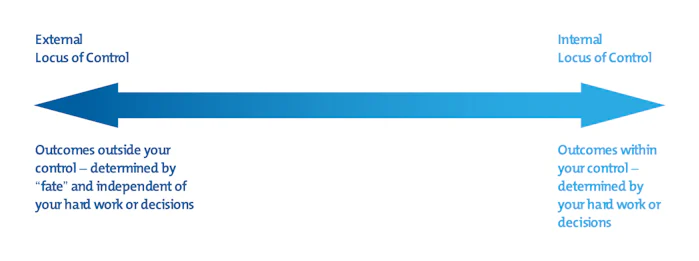
Most people fall somewhere between these two extremes, so Rotter devised a scale with external locus of control at one end and internal locus of control at the other (see figure 1, below).
Figure 1. The Locus of Control Scale.
Tip:
To find out where you fall on the Locus of Control scale, take our interactive quiz.
The Advantages of Having an Internal Locus of Control
There are advantages to having an internal locus of control. For example, studies show that it can make you a more effective leader, improve your performance, and enhance your job satisfaction.
Other benefits are that you will more likely:
- Take responsibility for your own performance: you "own" your actions and are not afraid to be held accountable for them, whether they result in success or failure.
- Be self-motivated: you believe that you can make things happen by yourself. This means that you work hard to learn new things, to overcome obstacles, and to achieve your goals.
- Have a higher degree of self-efficacy: this is your belief in your ability to succeed. If you have self-efficacy, you'll more likely take the initiative rather than procrastinate or wait for someone else to do a task, or hope that things just "fall into place" by themselves.
- Be more receptive to feedback: if you believe that you have the power to change things for yourself, you'll likely view feedback as an opportunity to learn and grow, rather than take it as personal criticism.
- Enjoy better mental and physical health: knowing that you are in control of your own life can help you to manage stress and anxiety more effectively. It may also encourage you to adopt healthier habits and behaviors. Studies show that "internals" report higher mental well-being and fewer physical symptoms of illness.
Conversely, if you have an external locus of control, you'll more likely:
- Blame poor performance or mistakes on things such as circumstance, "bad luck," or other people.
- Find it difficult to take the credit when things go right.
- Give up easily when faced with problems because you think "that's just the way it is."
- Be reluctant to forge new relationships, or repair broken ones, because you feel you have little power to change things.
- Resist making lifestyle changes that could improve your situation.
However, there can be times when having an external locus of control can be an advantage, particularly in situations where people need to be considerate and more easy-going.
People with a strong internal locus of control tend to be very achievement-oriented, and this can leave those around them feeling "trampled" or "bruised." And with a very strong internal locus of control, there is also a tendency to want to control everything, which can lead to difficulties in taking direction.
If you have a strong internal locus of control, make sure you pay attention to the feelings of the people around you – otherwise you'll seem arrogant, and they may not want to work with you.
Tip:
If you're a manager, it can be useful to consider where, in your experience and knowledge of them, your people fall on the locus of control scale, so that you can adapt your leadership style to suit to them.
"Internals," for instance, tend to prefer participative leaders who involve them in decision-making and allow them to work independently. In contrast, "externals" will likely respond better to a more direct style, because they tend to believe that external forces shape their lives.
How to Adjust Your Locus of Control
Your locus of control may be influenced by your upbringing, your cultural or religious background, or your life experiences. But it's important to note that, no matter where you fall on the locus of control scale, there is no "right" or "wrong" position.
You can move to a more internal position on the scale by taking control of the way you choose to react and adapt to your present circumstances, even if they are particularly difficult or are being impacted by powerful external forces. For instance, if you're working with a particularly difficult colleague or your organization is facing an unpredictable future.
Even if you've taken a wrong turn or made a mistake, adopting an internal locus of control means you are still in the driving seat, and therefore have the power to change your circumstances for the better.
For example, if you've recently lost out on a promotion, rather than quitting or simply continuing as before, you could choose to take control of the situation by analyzing the reasons why you didn't get the role and making some changes, such as taking on new responsibilities or asking for training that will improve your chances next time an opportunity arises.
In his article, The Locus of Control: Five Reminders That You Are the Boss, careers expert David G. Jensen identifies five areas where you can internalize your locus of control. He calls them the "Cs of Control." They are:
1. The Clock. You can't hold back time, but you can control how you use it. If you struggle to get everything done, make a positive effort to manage your time more effectively. For instance, by using prioritized To-Do Lists, minimizing distractions and avoiding procrastination.
2. Contacts. Build a powerful network of contacts by proactively seeking out people who can introduce you to new opportunities, or help you to achieve your goals and advance your career. Cultivate contacts at work, join professional forums and groups online, and connect, or follow people that inspire you on social media.
3. Communication. Develop your communication skills. This will enable you to present ideas more effectively, improve your workplace relationships, and help you to become more assertive.
4. Commitments. Always do what you say you're going to do and, if a project or request is beyond the scope of your expertise, don't be afraid to admit it. Remember that you can choose to say "No," particularly if people make excessive or unreasonable demands of you.
5. Causes. Make informed decisions about the projects or "causes" that you choose to get involved with at work. If you're initiating a project, use tools such as Decision Matrix Analysis or the Futures Wheel to fully assess the implications and risks of it before you proceed.
The C's of Control, adapted from "The Locus of Control: Five Reminders That Your Are The Boss" by David G. Jensen with permission pending from Science magazine. © The Association for the Advancement of Science, 2017.
Warning:
Take care not to go "overboard" in your attempts to strengthen your internal locus of control. If you do, you may find that your impulse is to try to control everything, which can lead to anxiety and stress. Ultimately, there will likely be some things that you just can't change, no matter how much you'd like to.
You can use the Control Influence Accept (CIA) Model to identify the aspects of a situation that you can and cannot control.
Key Points
Locus of control is a term first coined by psychologist Julian B. Rotter in 1954. It refers to the degree of control that people believe they have over their own lives.
If you have an internal locus of control, you'll likely believe that your life is shaped by your own actions, choices and decisions. In contrast, if you have an external locus of control, you'll likely believe that events are governed by forces beyond your control, such as chance, fate or other people who have more authority than you.
People with an internal locus of control tend to have greater career success and make better leaders. This is because they are able to take ownership of their work, are self-motivated, use feedback constructively, and are able to manage stress and anxiety better.
You can adjust your locus of control so that it is more internal by understanding that your circumstances are not a "given" and that you have the power to take control of them. You can do this by taking control of the way that you manage your time, your network, your communication, and your work commitments and causes.