

- Content Hub
- Business Skills
- Innovation
- Innovating for Business
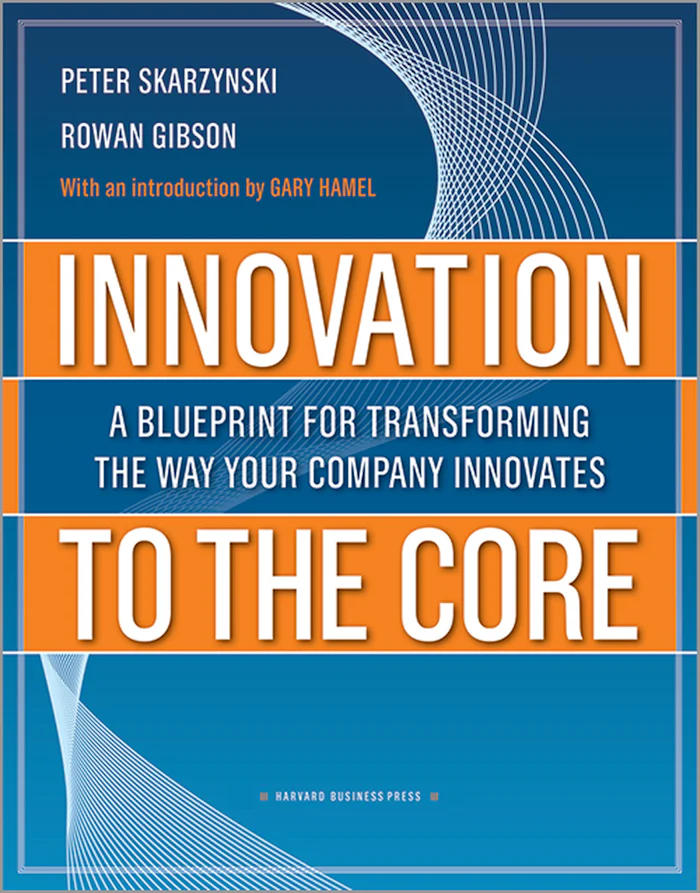
- Innovation to the Core: A Blueprint for Transforming the Way Your Company Innovates
Innovation to the Core: A Blueprint for Transforming the Way Your Company Innovates
by Our content team
Access the essential membership for Modern Managers
Transcript
Welcome to the latest episode of Book Insights from Mind Tools.
In today's podcast, we're looking at "Innovation to the Core," subtitled "A Blueprint for Transforming the Way Your Company Innovates." It's by Peter Skarzynski and Rowan Gibson, both experts in corporate innovation.
The book aims to teach organizations how to go from merely talking about innovation, to actually doing it. When you stop and think about it, most companies these days talk incessantly about being innovative. It's on their websites, in their annual reports, and in their brochures. And it's widely agreed that innovation is one of the few ways left for companies to create new wealth.
But how many of these companies actually make innovation part of their corporate culture? How many actually stress the importance of innovation to their employees, and provide an environment that really fosters creativity, empowerment, and free thinking? According to the authors, only a fraction of the companies that talk about innovation actually succeed in getting it embedded in their culture.
The authors say this is because most companies approach innovation the wrong way. The majority of companies look at innovation as something far off; they consider it a thing to be tackled by the Research and Development team, or something the new hotshot creativity consultant they just brought on board will take care of.
This approach rarely works. Companies that really want to become more innovative must make it a part of their everyday routine. They must create a process for innovation just like they've done for customer service or product quality. Innovation must start at the bottom, with the lowest-level employee, and work its way up to the top tiers of management.
Yes, it sounds like a major project, and the authors don't try to lull us into believing that it can happen overnight. They warn us straight off that making a cultural change to innovation is a lot of hard work. But it's easy to see that the hard work is worth it. Companies that have made innovation part of their identity are thriving. They're constantly generating new revenue streams, and wowing us all with their creativity and boldness.
It will be a fight, but it's a fight worth undertaking. Thankfully, we're not alone here. The authors have given us a map to guide the way. "Innovation to the Core" offers up specific techniques, principles, and methods that will help any company create and implement a culture of innovation.
"Innovation to the Core" is very much like a textbook, and that's meant as a compliment here. There's absolutely no fluff and no wasted space in this book. Every page is full of valuable information, and readers will be amazed at some of the creative, useful ideas that are presented in this book. By the end, with the authors as your guide, you'll really believe that innovation can be part of your company's future.
And the authors' opinions are worth listening to. Peter Skarzynski is the CEO and founding director of Strategos, an international growth and strategy firm. Rowan Gibson is a global business strategist and an expert on innovation; and he's the author of the bestselling book Rethinking the Future.
So, how do you know this book is for you? Well, if you've gotten fed up with your company buzzing about being innovative but not doing anything about it, if you want to stop your team members languishing in their cubicles unable to think of anything fresh and new to take what you're doing to a new level, or if you're tired of being jealous of Apple and Google's constantly changing array of cool products, then you won't want to miss this book.
One read-through is all it will take to convince you that innovation truly is possible, if you're willing to work for it. Your team has the creativity and drive to imagine new business ideas, explore opportunities, and retool old processes, if you just give them the chance. It's an exciting concept that the authors start pressing on us from the beginning.
So, keep listening to find out why diversity is so important to innovation; why analyzing your customers' annoyances can transform your business; and why you should invest money in ideas before you throw them out.
After the first chapter, which explains why innovation is so vital to business today, the book sets out three conditions that must be in place for creative breakthroughs to happen. The first condition is time and space; people need flexibility to imagine new possibilities, and time to work on these ideas.
The second condition is diversity. A diverse team, especially one with a wide range of thinking habits, will spark creativity and challenge the status quo.
And the third condition is conversation. Allowing your team to have a conversation about where the company is headed will allow breakthroughs to happen.
In the context of these three conditions, the authors state that the biggest barrier to innovation is lack of time. Most companies don't give their leaders, or their employees, enough free time to really reflect and come up with good ideas. They make an excellent point here. After all, when have you had enough free time to sit and think of something really creative? When was the last time you met with a group of co-workers simply to bounce around ideas for a new service?
They call the provision of innovation time "creating bandwidth," and there are plenty of companies that have created bandwidth in their organizations and have seen their profits soar as a result.
One great example is 3M, which allows employees to spend fifteen to twenty percent of their time working on their own personal projects using company resources. Google does much the same. This has resulted in many of the new, creative applications the companies have become famous for.
Next, the authors shed new light on the issue of workplace diversity, and talk about how important it is to the innovation process. If you think about your own company right now, the structure of leadership probably looks like a typical pyramid. You've got all your lower-level employees making up the base, and as you move up towards the peak, the levels get smaller and narrower, resulting in a very small area for senior management.
The point they make here is that most discussion groups take place toward the top of the pyramid, precisely where the least amount of diversity is located. Traditionally, this is the old guard; these are people who've been with the company a long time. They're the homogenous elite and usually, they're also out of fresh ideas.
So, where do you need to be looking for new ideas? At the bottom of the pyramid. This is where you've got a broad mix of young and old, men and women, creative and analytical.
This is where your company's future is! This is the group that knows your customers best. They're the ones out on the front lines, and they can probably give you loads of great ideas about how the company can improve. But this group is rarely, if ever, asked what they think.
The authors strongly suggest that companies reconsider the traditional organizational chart. They give specific instructions on how to turn around the prevailing culture to include this vanguard group, and why it's so important to start right now.
If you're feeling a bit helpless, and thinking that your company can never be like Apple or 3M or Google, then you won't want to miss the rest of this chapter. When the authors discuss the third condition you heard about earlier – the importance of conversation – you find out exactly how these forward-thinking companies use conversation to spur their own innovation.
It may surprise you to learn that employees didn't think up all these great ideas in some think tank or solitary office. They did it by mixing with people far different than themselves. And the authors show us how we can implement this in our own situations.
The next lesson the authors go to is about the four lenses of innovation. These are the four pillars that almost all innovative ideas are built upon. One of these pillars is the idea that most innovators challenge orthodoxies. Here's a good example of what this means: Furniture always used to be delivered to customers completely assembled. As far as the furniture industry was concerned, this was a no-brainer. After all, how else would you do it?
IKEA, as we all know now, saw things differently, and they set about challenging this orthodoxy in a way that shocked most people in the industry. The outcome was an entirely new business model that works for them.
The point that the authors bring up here is an excellent one for all of us to consider. It's so easy for us to accept conventional wisdom as the way it has to be. What's harder is remembering that we have the power to challenge these conventions. The authors dare us to be different; they dare us to challenge our mind-sets and look at the so-called norms in our industry. How could we turn them upside down?
This is a very exciting chapter because the authors give a detailed, step-by-step plan to turn us all into corporate rebels and find new ways of looking at old industries. For instance, one of the steps they suggest is to sit back and think about your customers for a minute. What does your company do that annoys or frustrates your customers? Your first instinct might be to think, Nothing! Of course the company's not annoying our customers!
Before you congratulate yourself on a job well done and move on, really stop and think about this. Look at your business from your customer's point of view.
To jump-start your thinking, consider the American airline, Southwest. Southwest knew they wanted to dramatically change the airline industry. They wanted their company to be fun, convenient, and inexpensive for travelers. Most airlines don't consider fun and convenience when looking at their business model, but Southwest wanted to turn the industry on its head.
They knew they would have to be innovative if they wanted to include these values, so they began asking a series of questions that challenged the traditional orthodoxies of the airline industry.
For example, they wondered why every other airline had such complicated and ever-changing fare structures; why couldn't they just offer one fare, and provide planes with one-class seating? This would make things simple and straightforward for their customers.
Another question they asked had to do with the planes themselves. Why did every other airline have so many different types of planes? Could they save money by having a fleet of just one type of plane? Could they pass those savings on to their customers?
Southwest became an innovative company, and now customers go out of their way to fly with them. All because they challenged the long-held orthodoxies of the airline industry and decided to do things differently.
The authors say that, most of the time, customers get annoyed when companies try to save themselves an inconvenience. Take a close look at your business. Are you doing anything to save yourself some stress that might be annoying or frustrating to your customers? This is a great way to discover an orthodoxy in your own industry, and then turn it on its head by doing something completely different.
The other three lenses the authors present in this chapter are just as relevant as the one on challenging orthodoxies. Readers will find them all specific, useful, and easy to implement, thanks to the detailed instructions.
Having spent the first half of the book teaching us how to build a platform and framework for jumpstarting innovation, the authors now turn to taking action. Here's where we learn how to start implementing, and sustaining, an innovative company.
For example, the authors give us their take on how to evaluate ideas. All too often, they say, ideas are killed far too early. Why? Because leaders want to know straight off what their return on investment is going to be. But, how can you possibly tell at such an early stage? The point here is that you can't. Yes, it's important to look at profitability, but only after an idea has had a chance to grow and develop. What you need to ask first is: how radical is the idea? How big or important could this be?
Learning how to ask the right questions, at the right time, is key to making sure that your company gives good ideas the time they need to develop.
Now, we've said it before and we'll say it again: this book truly has everything you need to know about how to develop and implement innovation in your company. It's really like a textbook. It's full of thought-provoking questions, step-by-step instructions, and plenty of relevant suggestions for each stage of the innovation process. Even if this book insight was an hour long, we couldn't have covered half the great ideas the authors give us.
This is definitely not a book to be missed. It more than keeps its promise of teaching us why innovation is so important to a company's future. And, we're given every tool we need to get started.
But beware: After you read this book you'll have no more excuses to drag your feet and keep following the status quo. And to be honest with you, you won't want to. The authors do a fantastic job of getting us excited about what's possible when we collaborate and pool our resources.
"Innovation to the Core" is a must-read for anyone who's ready to live on the edge and start transforming their business into something truly unique and remarkable.
"Innovation to the Core" by Peter Skarzynski and Rowan Gibson is published by Harvard Business Press.
That's the end of this episode of Book Insights.


