Access the essential membership for Modern Managers
If your heart sinks at the thought of presenting information to an audience, you're not alone! Many people struggle with delivering their message. It's a skill you need to learn and practice.
When trying to get your point across, either in speech or writing, you often only get one shot – and if you lose your audience, you may not get them back.
This is why you need to choose your words carefully, and present your points in a style, manner and sequence that best suits your message. The Rhetorical Triangle is a tool that helps you to get your thoughts in order and present a clear position.
In this article, we explore how you can use it to improve your written and verbal communications.
Understanding the Rhetorical Triangle
Rhetoric is the ancient art of using language to persuade. If you use it well, your audience will easily understand what you're saying, and will more likely be influenced by it.
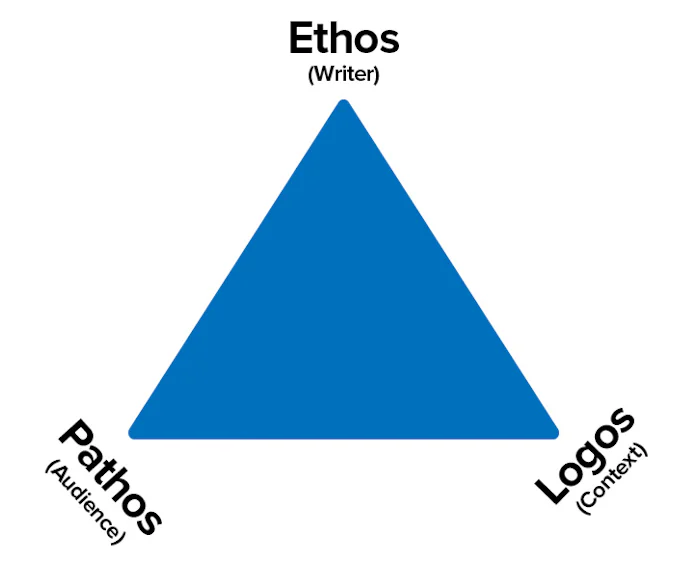
The three points on the Rhetorical Triangle relate directly to the three classic appeals you should consider when communicating:
- Ethos: building trust by establishing your credibility and authority (Writer).
- Pathos: appealing to emotion by connecting with your audience through their values and interests (Audience).
- Logos: appealing to your audience's intelligence with well-constructed and clearly argued ideas (Context).
These three elements are shown in figure 1, below.
Figure 1: The Rhetorical Triangle
These three elements will determine the persuasiveness of your argument. Your writing, or other form of communication, needs to consider all three. Let's look at them in more detail.
Ethos (Writer)
The way in which the writer (or speaker) affects the argument is known as ethos.
From the outset, you need to clarify who you are, why you are competent to speak on the issue, and where your authority comes from.
Your audience might be wary that you're trying to change their opinions or beliefs. If you don't make it clear why you are addressing them, some people might assume that you are hiding something.
Whether you're presenting ideas for problem solving, analysis, or just to entertain, your audience will try to figure out your motives, beliefs, values, and assumptions. This allows them to evaluate your credibility and decide whether you are being sincere.
Pathos (Audience)
When you communicate, you need to understand your audience and appeal to their emotions. This is known as pathos.
Consider the audience's expectations – what are they hoping to take away from what you say? Be clear about why you are communicating with this audience in the first place, and plan out your communication style in advance, with the audience firmly in mind.
Knowing your audience helps you to avoid alienating them by using technical terms or jargon that they may not understand, or by "dumbing down" the content, if your message is intended for professionals.
Think about the emotion you want to evoke. Are you addressing a pain point, seeking their trust, or inviting their loyalty?
Logos (Context)
Finally, your audience will analyze your message by putting it into context. Here the emphasis is on logic and reason, or logos (pronounced log-oss).
Your audience will likely consider the background to your communication, and the circumstances or events that preceded it. They'll analyze the kinds of arguments you used, their relevance, and whether you delivered them in a clear, coherent and appropriate way.
Your audience must be able to follow what you are saying for it to be believable. They'll be looking for a logical, well-constructed argument, and evidence for any claims that you make. They'll also be thinking about any possible counterarguments.
Tip:
The Rhetorical Triangle can help you to prepare the structure of your communication. Use The Five Canons of Rhetoric to organize, prepare and plan the content of your message.
Using the Rhetorical Triangle
When you prepare a written document, speech or presentation, consider the three elements of the triangle. If your communication is lacking in any of the three areas, you'll decrease the overall impact of your message.
You can use the following three steps as a guide. And Mind Tools Club members can see a bonus worked example, using the three elements of The Rhetorical Triangle, at the end of this article.
1. Establish Your Credibility (Ethos)
For your message to be convincing, you need to demonstrate that you are a reliable and trustworthy source. Answer the audience's unspoken question, "Is the source credible?"
First, establish who you are as a person.
- Reveal your biases, beliefs, values, and assumptions, as appropriate.
- Explain where your expertise comes from.
- Use expert testimony.
- Show why you should be considered an authority.
Then, consider the purpose of your communication. Is it:
- A call to action?
- To provide information?
- To educate?
- To persuade or change a perspective?
- To present ideas?
- To entertain?
2. Appeal to the Audience's Emotions (Pathos)
Understanding your audience enables you to connect with them, and gives your message more impact.
Appeal to their emotions (where this is appropriate and honest) and answer their question, "Is this person trying to manipulate me?"
Ask yourself who the members of your audience are.
- What are their expectations?
- Why are they reading (or listening) to me?
- How will they use this information?
- What do I want them to take away?
Consider how you can connect with them emotionally.
- What emotions do I want to evoke?
- Do I use anecdotes or personal stories?
3. Consider the Context (Logos)
Think about the context of your message, the best channel of communication, and how to deliver it with a solid appeal to reason. Answer the audience's question, "Is the presentation logical?"
Think about how you'll present the information.
- What type of reasoning will I use?
- How will I support my position? With statistics? Evidence? Observations?
- What tone will I use? Formal or informal?
- What is the best way to communicate the message? Presentation? Email? Blog?
Take into account what events surround the communication.
- What background information do I need to supply?
- Are there important counterarguments I should bring up and deal with?
- Does the method or location of my communication fit with its message?
When you take into consideration the three corners of the Rhetorical Triangle, you're better able to position your points in a way that your reader (or listener) can understand and get on board with.
By taking time to understand the art of rhetoric, you'll give your communications more credibility, power and impact.
Mind Tools Club members can see a bonus worked example of the Rhetorical Triangle below.
Key Points
Making persuasive arguments is not always easy. But you can give your message far greater impact by keeping in mind the three elements represented by the Rhetorical Triangle. They are:
1. Ethos (writer) – your credibility and authority.
2. Pathos (audience) – how your message appeals to the audience's emotions.
3. Logos (context) – your logic and reasoning, and how your message fits with the audience's understanding of the subject.
By paying attention to these points, you can ensure that your audience receives your message in the way that you intended. And it can help to address any concerns before they even have a chance to surface.
{{php}} if(isset($is_public)) { {{end_php}}
Join the Mind Tools Club to see the worked example.
{{php}} } else { {{end_php}}
Using the Rhetorical Triangle: an Example
Good morning, everyone.
I'm Helen Brooks, and I'm the new VP, Change Management. I'd like to take a moment of your time to introduce myself and talk briefly about the forthcoming reorganization that's happening within the company.
[Ethos – the Writer]
I come from a background in the telecoms industry, where I have been responsible for managing major reorganizations within several large companies. Before that, I trained as a learning and development manager, and saw first hand the effects of large-scale reorganizations on my own role – for better and for worse!
My purpose in writing this note to you is to introduce our feedback and communication strategy, which will keep you all informed and engaged with the changes that we'll be making. We hope to build your understanding of the process, and show you how you can be a part of its success.
[Pathos – the Audience]
Inevitably, in these situations, people become anxious and unsettled. Having been through company mergers earlier in my career, I understand that. I also understand that anxiety breeds rumors, which will likely be inaccurate and could be damaging. So I'm implementing a series of forums at which managers will take questions and give answers as openly and honestly as they can.
[Logos – the Context]
The benefits of the internal reorganization will be substantial. We aim to align key roles more effectively, streamline functions, and increase productivity – without anyone having to take on more work.
Our aim is that you'll all be able to do your jobs more efficiently, and enjoy them more. A key part of that is working to ensure that you all understand and support this initiative.
So please give us your honest feedback as the process develops, and together we'll make this work!