Access the essential membership for Modern Managers
Key Takeaways
- Force Field Analysis was developed by Kurt Lewin in the 1940s for social psychology and is now widely used in business for decision-making.
- It’s a structured approach that identifies the forces that drive or resist change.
- Force Field Analysis can improve the quality of decision-making for both simple and more complex decisions.
- It is ideal for evaluating "go/no-go" decisions and ensuring effective change management.
Some people struggle when they have tough decisions to make. They hash through the pros and cons, and agonize over making the right call.
When you're making challenging decisions, it pays to use an effective, structured decision-making technique. Force Field Analysis is one such technique. In this article, and in the video, below, we'll explore what it is and how you can use it.
About Force Field Analysis
Force Field Analysis was created by Kurt Lewin in the 1940s. Lewin originally used it in his work as a social psychologist. Today, however, it's also used in business, for making and communicating go/no-go decisions.
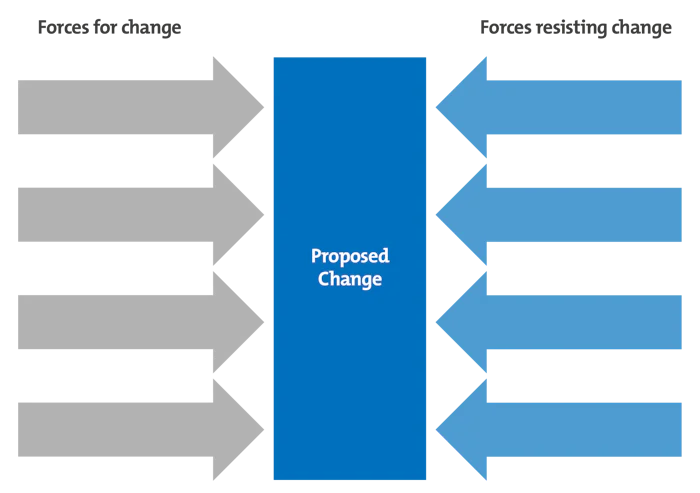
The idea behind Force Field Analysis is that situations are maintained by an equilibrium between forces that drive change, on one side, and others that resist change, on the other. See figure 1, below.
For change to happen, the driving forces must be strengthened or the resisting forces weakened.
Figure 1 – Force Field Analysis
Force Field Analysis is helpful for analyzing the forces for and against a change, and for communicating the reasoning behind your decision.
Force Field Analysis Template
To carry out a Force Field Analysis, find a blank sheet of paper or a whiteboard, or download our worksheet.
How to Use Force Field Analysis
Once you've done that, follow these five steps:
Step 1: Describe Your Plan or Proposal for Change
Define your goal or vision for change, and write it down in a box in the middle of the page.
Step 2: Identify Forces For Change
Think about the kinds of forces that are driving change. These can be internal and external.
Internal drivers could include:
- Outdated machinery or product lines.
- Declining team morale.
- A need to increase profitability.
Your external drivers could include:
- A volatile, uncertain operating environment.
- Disruptive technologies.
- Changing demographic trends.
Tip 1:
It's important to identify as many of the factors that will influence the change as you can. Where appropriate, involve other people, such as team members or experts in your organization.
Tip 2:
The following questions may help you to identify forces that will influence the change:
- What business benefits will the change deliver?
- Who supports the change? Who's against it? Why?
- Do you have the resources to make the change work?
- What costs and risks are involved?
- What business processes will be affected?
Tools such as the Futures Wheel, Impact Analysis, "What If" Analysis, Stakeholder Analysis, and brainstorming can also help with this step.
When you've identified the forces that are driving change, add them to the left-hand side of your Force Field Analysis.
Step 3: Identify Forces Against Change
Now brainstorm the forces that resist or are unfavorable to change.
Internal resistors and restrainers could include:
External factors might be:
- Existing commitments to partner organizations.
- Government legislation.
- Obligations toward your customers.
Now add the forces against change to the right-hand side of your Force Field Analysis.
Step 4: Assign Scores
Next, score each force, from, say, one (weak) to five (strong), according to the degree of influence each one has on the plan, and then add up the scores for each side (for and against).
For a visual representation of the influence that each force has, draw arrows around them. Use bigger arrows for the forces that will have a greater influence on the change, and smaller arrows for forces that will have a weaker influence.
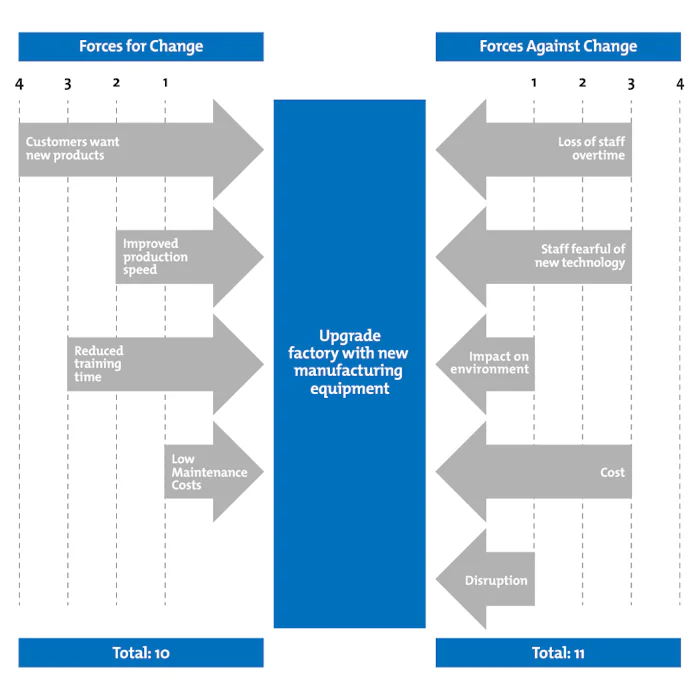
By now, your Force Field Analysis should look something like the example in figure 2, below.
Example of a Force Field Analysis (Figure 2)
Image adapted from “Tools for Knowledge and Learning A Guide for Development and Humanitarian Organizations” by Ben Ramalingam © Overseas Development Institute 2006. Adapted with permission from Ben Ramalingam.
Step 5: Analyze and Apply
Now that you've done your Force Field Analysis, you can use it in two ways:
- To decide whether or not to move forward with the decision or change.
- To think about which supportive forces you can strengthen and which opposing or resisting forces you can weaken, and how to make the change more successful.
If you had to implement the project in the example above, the analysis might suggest a number of changes that you could make to the initial plan. For instance, you could:
- Train staff to minimize their fear of technology. The +1 cost of training increases "Cost" to -4 but the -2 benefits reduce "Staff fearful of new technology" to -1.
- Show staff that change is necessary for business survival. This new, +2 force supports the change.
- Show staff that new machines would introduce variety and interest to their jobs. This new, +1 force also supports the change.
- Raise wages to reflect new productivity. The +1 cost of raising wages takes "Cost" to -5, but the -2 benefits reduce "Loss of overtime" to -1.
- Install slightly different machines with filters that eliminate pollution. The -1 benefit of the new machines eliminates "Impact on environment" as a force against change.
These changes would swing the balance from 11:10 (against the plan), to 13:8 (in favor of the plan).
Tip 1:
Some factors, where you need absolute certainty in order to make a good decision, don't fit well with this approach. Considerations that affect people's health and safety, for example, aren't suited to Force Field Analysis. Be sure to deal with these appropriately, whatever the outcome of your analysis.
Tip 2:
Bear in mind that, while Force Field Analysis helps you to understand the impact of different factors on your decision or change, it can be subjective. If you're making an important decision, using it alongside other decision-making tools such as Decision Matrix Analysis, Decision Tree Analysis, and Cost/Benefit Analysis will help to reinforce the quality of your decision.
Tip 3:
Don't underestimate how much work a Force Field Analysis can involve. We've used a simple example here, but there will be many factors that you'll need to consider for complex decisions and changes.
FAQ
What are the benefits of Force Field Analysis?
Benefits of the Force Field Analysis technique include the following:
- It provides a visual representation of the factors to consider when making a decision.
- It helps identify key obstacles to change.
- It encourages team participation and consensus building.
What are some common applications of Force Field Analysis?
Force Field Analysis technique can be used in a variety of contexts including organizational-change initiatives, strategic planning, and process improvement. It has often been used effectively in sectors such as healthcare, education and government.
Is Force Field Analysis applicable to both individuals and organizations?
Yes: it's a versatile tool that can be applied to individual decision-making processes as well as organizational-change initiatives.
What are some limitations of the Force Field Analysis technique?
As with any process, it has some potential flaws.
- It can be subjective, as different people will have different opinions about how forces should be scored.
- It may oversimplify complex issues.
- It requires thorough and honest input from all stakeholders.
Key Points
Force Field Analysis helps you to think about the pressures for and against a decision or a change. It was developed by Kurt Lewin.
To carry out a Force Field Analysis, describe your plan or proposal in the middle of a piece of paper or whiteboard. Then list all of the forces for change in a column on the left, and all of the forces against change in a column on the right.
Score each factor, and add up the scores for each column. You can then decide whether or not to move forward with the change.
Alternatively, you can use your analysis to think about how you can strengthen the forces that support the change and weaken the forces opposing it, so that the change is more successful.