

- Content Hub
- Business Skills
- Business Ethics and Values
- Equity, Diversity and Inclusion
- Bias Interrupted and The End of Bias

Access the essential membership for Modern Managers
Transcript
Hello. I'm Frank Bonacquisti.
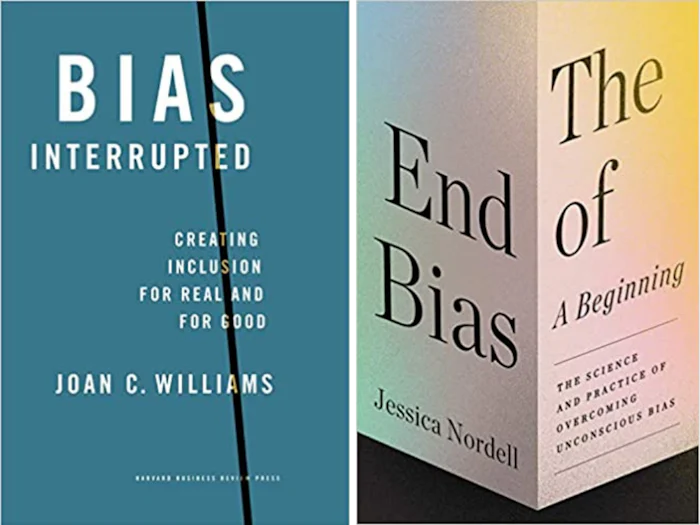
In today's podcast, lasting around 15 minutes, we're looking at two books, "Bias Interrupted: Creating Inclusion for Real and for Good," by Joan C. Williams, and "The End of Bias: A Beginning: The Science and Practice of Overcoming Unconscious Bias," by Jessica Nordell.
The subject matter of these two books is clearly similar. The titles tell you that. But their approaches are very different – different enough that they complement each other really well. That's why this Book Insight covers both of them, side by side.
These books ask vital questions that have become more pressing in recent years: how do we rid our organizations of discrimination, whether it's on the grounds of race, gender or sexuality? And how do we confront our own unconscious biases?
Discrimination currently has a huge media profile. Large-scale movements like Black Lives Matter and MeToo have driven the issue to the top of the news agenda.
Many organizations have developed programs aimed at fostering diversity, equity and inclusion in the workplace. And yet there still seems so much to do. Some of the most forward-looking of these organizations continue to report high turnover among certain key groups. The diversity programs don't seem to be working. Why not?
The answer may lie in unconscious bias. It's the kind of deeply buried prejudice that can make even well-meaning, liberal-minded people make biased decisions about others – without even realizing it. In fact, people who exhibit it are often shocked and horrified to be told about their behavior. They may push back against the suggestion that they're biased. But they very often are.
So who would benefit from reading these books? "Bias Interrupted" is a practical handbook for managers and human resources executives. It gets straight to the point, showing precisely how to change the Diversity and Inclusion culture of an organization.
"The End of Bias" takes a wider view. Its approach is to outline the extent of the problem and then show what people are doing to deal with it. It doesn't give readers a specific plan for tackling the problem, but it does show its extent and depth. So it will interest anyone who wants to know more about bias, and particularly unconscious bias.
So keep listening to learn the five types of workplace bias, how to run appraisals without unconsciously discriminating, and how the Los Angeles Police Department tore up the rulebook to build bridges in one of the city's toughest areas.
The author of "Bias Interrupted" is Joan C. Williams. She's a professor of law, and a founding director of the Center for Work Life Law at the University of California, Hastings College of the Law. She's also a TED Talk veteran, and a widely read commentator on diversity and inclusion in the workplace.
Jessica Nordell, the author of "The End of Bias," has a wide-ranging résumé. She's a Harvard physics graduate with a postgraduate qualification in poetry. She's been a radio comedy writer, producer and computer programmer. Now she works as a full-time writer.
So how do these books tackle the subject of bias? As you heard earlier, "Bias Interrupted" is all about getting things done. Each of the 15 chapter titles poses a question. Some of them are provocative, like: should meritocratic companies change their approach? Do white men really have it easy? Is bias training worthless?
The method is clear, and clearly stated. Each question addresses an issue any manager or HR executive will need to handle when promoting diversity in their organizations. And each chapter gives direct advice on that subject, with plenty of data to back it up. There are also links to Williams' website, hosting a range of resources and exercises the reader can download.
So what's the argument? Williams identifies five types of workplace bias:
Prove-it-again bias means some groups are made to show themselves capable more often than others. A successful negotiation by a female lawyer might be seen as a one-off by a male partner, for example. The bias may even persist after several instances where she's proven her skill.
Tightrope bias means some groups need to be smarter at office politics to succeed, even when they're behaving exactly like their more-privileged peers. Black employees will likely be labeled angry and pushy, when white colleagues showing similar behavior are called assertive and ambitious.
Tug-of-war bias means that bias against a group can fuel conflict within that group. A woman might choose not to support another woman who's been criticized in a meeting, even if she thinks the criticism unfair. She might not want to be told by male colleagues that she's only doing so to show gender solidarity. And yet speaking up is the right thing to do, and not doing so leaves the other woman feeling angry and isolated.
Racial stereotyping disadvantages anyone who's not of the dominant group. Asian men are credited for their technical expertise, but not so much for their management skills, for example.
And Williams identifies maternal wall bias as the strongest form of workplace discrimination against women. A mother will often face assumptions that she doesn't concentrate as well on her job, or commit to it with the same intensity as a woman without children. She certainly won't function as well as a man, who presumably has someone else looking after his kids.
In response to all these kinds of bias, Williams proposes her "bias interruptions." These are data-driven and carefully measured interventions any manager can make to address bias.
Consider prove-it-again bias, for example. Williams shows that in performance appraisals, disadvantaged groups will more likely have mistakes highlighted, and successes downplayed. The same criteria for success are not applied across the board. So they need to be, with a documented record of what those criteria are.
Next, the appraiser needs to show evidence that the criteria have been met. This discourages undue leniency toward favored groups, who might otherwise be given the benefit of the doubt. It also prevents managers from downplaying achievement by those in less-advantaged groups.
Finally, appraising managers need to be accountable for their decisions. This is equally true in hiring, and in assessment for promotion. If the appraisal system requires a manager to explain their decisions, they're far more likely to act fairly.
These interruptions are relatively simple changes to basic processes. They don't require mountains of paperwork, or a demolition of existing organizational culture. And research data shows that they work.
Research data plays a key role in "The End of Bias," too, although it's a very different kind of book. It's a manifesto for change, rather than a to-do list. But it's still rooted firmly in the science of the subject. And its examples of challenges to bias are very much based in the real world.
Take the example of the police force in Watts, Los Angeles, and how it confronted its inherent bias. Watts is a tough neighborhood, with high crime rates. There's little scope for applying academic theories there.
Around the turn of the millennium, police operations were confrontational, based on the belief that widespread criminality should be met with equivalent force. That was as far as the relationship between the police and the policed went.
But this poisonous situation changed when the Los Angeles Police were persuaded to change tack – to stop treating the people of Watts like the enemy, and to start seeing them as people. As a community with needs and hopes.
New relationships and community safety were prioritized over making arrests. New officers received education about the history of the area and its policing. Black and Latino officers were recruited as a priority.
The situation improved. Watts is still a tough neighborhood, but it has less crime. And police officers are more likely to resolve a situation by communication and cooperation than by force.
Nordell's book is organized in three parts. The chapter on Watts is in Part Two, titled Changing Minds. It's about how bias can only be overcome by a shift in prevailing attitudes and assumptions, as you'd expect from that title. But the process of change is only part of the story.
Part One covers how bias works. And it's here that Nordell traces how unconscious bias takes root in otherwise-liberal minds.
It still isn't fully clear why well-intentioned people show bias. But they do. Even those who agree that all people are fundamentally equal can and do act in prejudiced ways. And they usually don't know they're doing it. The science is complex, and doesn't yet have any final answers. But we do know that, for many of us, acting with bias conflicts with our values. Feeling the discomfort of guilt, faced with our actions, may be the beginning of our ability to change.
One thing's for sure: bias has a lot to do with prediction. We like to be proved right, even when the outcome of our prediction is bad. And we don't like to be wrong. So when we meet someone who challenges a stereotype that we hold subconsciously, we don't like it.
Men, particularly, will likely feel challenged when confronted with women who don't conform to their predictions. Assertive women are seen as bossy. Ambitious women are cold and uncaring.
And there's a particular double standard at work when a woman is also a mother. Mothers who return to work are often stereotyped as being less committed to their jobs, because they're mothers. But they're also judged negatively because they have returned to work, rather than staying at home to look after the baby.
But the fact that people enjoy prediction, and don't like to be wrong, is only part of the story of how bias develops.
It seems that the foundation for bias is not the differences we see between people. It's how much our culture tells us these differences matter. Experiments with young children have shown that when differences are emphasized, the children will discriminate according to the emphasis.
So if gender is marked out as an indicator of status, then the children will discriminate on that basis. But if classes are divided on the basis of shirt color, for example, the children will identify with others who wear the same color. They'll also discriminate against those who don't. And such discrimination can become a habit.
That's because of the two different ways humans think. We think deliberately, and with effort, when we're figuring something out. But we also think rapidly and automatically when we're doing something familiar. And sometimes the two ways of thinking contradict each other.
So people can think they're not biased, even when they are. Their deliberate, conscious thoughts may reject bias as an affront to their values. But at an unconscious level, they're making biased decisions all the time. They're conditioned to be biased, by a subtle range of stimuli and experiences. And it's because bias is so often habitual that it can be so hard to shift.
Part Three of "The End of Bias" is called Making It Last. And it's here that Nordell examines the promise made in the title of her book, that we may be able to look to a future in which there is no bias.
To achieve this, people in privileged groups have to recognize and confront the factors that shape their bias. It's a tough ask. The recognition needs to take place at the individual level, and across societies. And it needs to acknowledge all the harm that bias has done, whether that harm is physical, material, economic, or psychological.
Nordell's writing becomes strikingly personal in the book's conclusion. She traces the history of bias in her own family, and in herself. She also outlines what she's done to address her own unconscious bias. At the book's outset, she talks about herself as a victim of bias, as a woman working in science. By the end, she's acknowledging her own status as a perpetrator. It's an emotional process.
So what do we make of these two books? The most compelling thing they have in common is the passion with which they're written. Both authors are absolutely committed to the cause of diversity, equity and inclusivity. And in both cases, any doubters had better be ready for a formidable weight of research and anecdote.
Nordell's book seeks to inspire with a vision of the future. It's a call to action written by a natural storyteller. That's not to say that it skimps on the here and now, or flinches from the ugliness of the past. But its eyes are always on what we might, or must, achieve in the future. Examples of how we might get there abound, but this isn't a practical manual.
Williams, on the other hand, has written exactly that. Her style is brisk, conversational, and sometimes funny. But she focuses fully on how to root out bias, right now. Managers can pick up this book and put its principles into immediate effect. HR executives will find a readymade template for a diversity policy. And Williams' track record for getting results is impressive.
Read separately, these are two mighty impressive books. Read together, they make it clear that one of the toughest tasks in human resource management is not only achievable, but vital.
"Bias Interrupted: Creating Inclusion for Real and for Good," by Joan C. Williams, is published by Harvard Business Review Press. "The End of Bias: A Beginning: The Science and Practice of Overcoming Unconscious Bias," by Jessica Nordell, is published in the United States by Metropolitan Books, and in the United Kingdom by Granta Books. Please note the U.K. title: "The End of Bias: How We Change Our Minds."
That's the end of this episode of Book Insights. Thanks for listening.


