


It takes a lot of effort to keep a large project running smoothly. With a large number of variables, people, and deliverables, it’s hard to keep on top of everything that’s happening. Consider the following scenario:
Hal (the distressed project manager): "What do you mean, we don’t have the test results yet?! What has Katy been doing? Get Katy!"
Katy: "No, Hal, I wasn’t responsible for getting that done. Joan has more expertise in that area, remember? I’ll ask Joan what happened."
Joan: "Gee, Katy, I know I have more experience with these reports, but I was waiting for you to contact me so we could review them together."
Do you recognize anyone you know? This type of situation is repeated daily in organizations across the globe. And most of the time, there’s no incompetence or bad intentions involved. More often, problems like this are the result of inadequate planning and poor communication.
Successful projects have a clear breakdown of who is ultimately responsible for each aspect of the project. Without clear, written, and agreed-upon accountability, it’s far too easy to for communication to fail and for responsibilities to be muddled.
So how do you avoid this?
Access the essential membership for Modern Managers
Developing a Responsibility Assignment Matrix
One tool that project managers use to keep these assignments clear is the Responsibility Assignment Matrix (also called the RAM, or the Responsibility Matrix). This matches deliverables with the people who are responsible for them. For every piece of the project, the matrix shows who needs to contribute what for the project to be completed.
For example, let’s say that you’re upgrading your customer service delivery system, and you need to train your staff to use new procedures and tools.
Step One: Define Your Deliverables
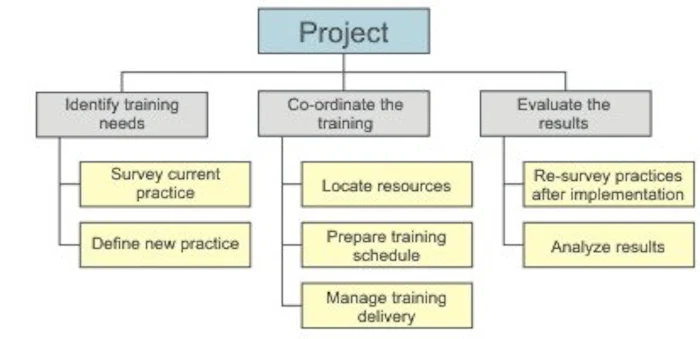
Using a Work Breakdown Structure, you define three key deliverables for this training project, with a few subcategories for each:
- Identify training needs:
- Survey current practice.
- Define new practice.
- Coordinate the training:
- Locate resources.
- Prepare training schedule.
- Manage training.
- Evaluate the results:
- Re-survey practices after implementation.
- Analyze results.
Access the essential membership for Modern Managers
Tip:
A Work Breakdown Structure (WBS) is a project planning tool used to break a project down into smaller, more manageable pieces of work (deliverables). It's not a list of every task: rather, it's a "tree" structure showing the meaningful groups of activities that make up the main segments of the project.
Step Two: Identify the People Involved
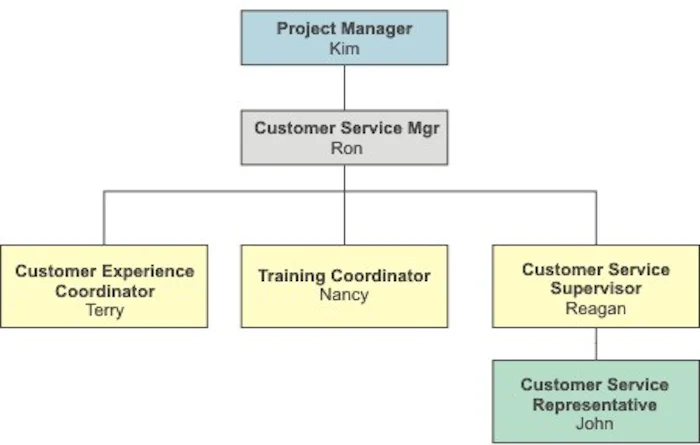
Map out who is on your project team. By creating a chart of individuals who are available, you can then delegate work assignments based on expertise, and you can recruit talent that you’re missing. This step is often called an “Organization Breakdown Structure” because it creates an organizational chart for your team.
Level 1
Project Manager: Kim
Access the essential membership for Modern Managers
Level 2
Customer Service Manager: Ron
Level 3
Customer Experience Coordinator: Terry
Training Coordinator: Nancy
Customer Service Supervisor: Reagan
Level 4
Access the essential membership for Modern Managers
Customer Service Representative: John
Step Three: Create Your Responsibility Matrix
Draw a matrix. The deliverables are the column headings, and the people are the row titles.
Identify training needs
Access the essential membership for Modern Managers
Coordinate the training
Evaluate the results
Person
Survey current practice
Define new practice
Locate resources
Prepare training schedule
Access the essential membership for Modern Managers
Re-survey practices
Analyze results
PM: Kim
A
A
A
Access the essential membership for Modern Managers
A
CSM: Ron
A
R
I
Access the essential membership for Modern Managers
A
R
CEC: Terry
R
C
Access the essential membership for Modern Managers
R
R
TC: Nancy
I
R
R
Access the essential membership for Modern Managers
CSS: Reagan
R
C
C
Access the essential membership for Modern Managers
R
C
CSR: John
C
C
Access the essential membership for Modern Managers
C
With your team, determine accountabilities as well as other levels of involvement for each item in your Work Breakdown Structure.
A useful framework to determine role assignments is RACI. This defines four levels of involvement:
R = Responsible (People who do the work).
A = Accountable (People who make sure the work gets done).
C = Consulted (People who provide input before and during the work).
I = Informed (People who are kept informed of progress).
Project Management Institute, "A Guide to the Project Management Body of Knowledge (PMBOK Guide)" – Fifth Edition, (2013). Copyright and all rights reserved. Material from this publication has been reproduced with the permission of PMI.
Other levels of involvement may include “assist”, “coordinate”, “sign off”, and “review”. You can decide how to assign responsibility for your project and your team. But you must be sure that ultimate accountability and responsibility for performing the work are agreed upon and communicated.
Access the essential membership for Modern Managers
Step Four: Communicate
When your Responsibility Assignment Matrix is complete, communicate it to all stakeholders. It’s a good idea to post it in an area where people will see it. Used effectively, the RAM helps people understand what they should be doing at all stages of the project.
Key Points
Project teams can easily lose focus on what needs to be done and who needs to do it. People may assume that somebody else is doing something – and before long, key pieces of work fall behind schedule.
To avoid this common problem, consider developing a Responsibility Assignment Matrix for your team. This matrix clearly identifies which role each team member has agreed to take on for each of the project’s main deliverables.
With these assignments, you can eliminate miscommunication about who’s doing what – and you can help to ensure that your project is successful.
Share this post
Discover more content

Dennis Lock: The Structure of Project Teams
We outline Lock’s arguments for and against two different types of project team and highlight some of the issues that organizations should be aware of when deciding how to structure a project team.

The Program Management Team
This article discusses how a program management organization is formed and what is involved in the key roles.

Stakeholder Analysis
Use Stakeholder Analysis to identify and understand people with influence over your project. Try our three-step process, with interactive app and template.