Access the essential membership for Modern Managers
Key Takeaways
- The Johari Window is a framework you and your team can use to develop better self-awareness of your conscious and unconscious biases.
- You can use it to compare what you consider to be your own strengths and weaknesses to others' perceptions of them.
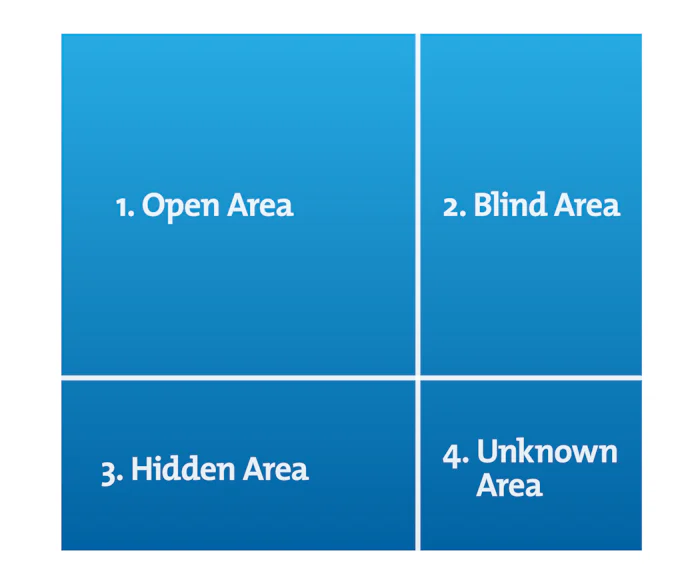
- The Johari Window is split into four quadrants: the Open Area (things you know about yourself), the Blind Area (things you don't know about yourself, but others do), the Hidden Area (things you know about yourself, but keep hidden), and the Unknown Area (things that are unknown to you and to others).
- You can use the Johari Window in your organization to build trust, develop self-awareness, and improve understanding and interpersonal relationships with your colleagues.
Have you ever been part of a team whose members were all open and honest with one another?
If so, then chances are you worked extremely effectively together. You and your colleagues likely knew everyone's strengths and weaknesses, and enjoyed high levels of trust. Such a positive working environment probably helped to create a top-performing, tight-knit unit.
Teams rely on a combination of self-awareness and trust to run like a finely tuned machine. But how do you build those qualities?
In this article and in the video, below, we look at how you and your team members can use the Johari Window to develop self-awareness, trust and communication, and so grow as people and as colleagues.
Johari Window Definition
The Johari Window is a visual framework you can use to understand more about your conscious and unconscious biases. Doing this can improve your self-awareness and your understanding of others. But it can also be used as a personal development tool, and to build better workplace relationships.
The name "Johari" is a combination of the names of psychologists Joseph Luft and Harry Ingham, who created the model in 1955.
What are the Three Main Goals of the Johari Window?
The Johari Window can help you and your team in three main ways:
- By building trust with others through sharing information about yourself.
- Improving your own self-awareness by discovering what other people think about you, your strengths, and your weaknesses - and comparing this feedback to the perception you have yourself.
- Improving communication and team interpersonal relationships.
What Are the Four Quadrants of the Johari Window?
The Johari Window may look complicated (see figure 1, below), but it is actually easy to use and understand. It is split into four quadrants, each of which contains information about the things you perceive about yourself and how others perceive you.
Figure 1: The Johari Window
Adapted from "Of Human Interaction," by Joseph Luft. © 1969. Reproduced with permission from McGraw-Hill Education.
Now, let's explore the four quadrants of the Johari Window in more detail:
1. Open Area (Quadrant 1)
The Open Area represents the things that you know about yourself and that others know about you. This includes your behavior, knowledge, skills, attitudes, and "public" history.
The ideal Johari Window (see figure 2, below) has a large Open Area. This is because, in general, the more that people know about themselves and one another, the more productive, cooperative and trusting they'll be when working together.
Figure 2: An Ideal Johari Window
2. Blind Area (Quadrant 2)
The Blind Area represents things about yourself that you aren't aware of, but that others know about you. For example, you might not realize that you're a great listener until someone points it out to you. It can also reveal deeper issues, such as feelings of incompetence or anger that you haven't faced up to, but that others sense in you.
A small Blind Area indicates that you're aware of how your behavior affects other people, whereas a large Blind Area suggests that you may be naive or even in denial about it. A large Blind Area could also mean that your colleagues are keeping what they know about you to themselves.
No one works at their best when they're "in the dark," so it's important to reduce the size of your Blind Area. You can do this by following the tips and strategies in our article, Developing Self-Awareness.
3. Hidden Area (Quadrant 3)
The Hidden Area represents things that you know about yourself, but that you keep hidden from other people.
You don't need to share all of your private thoughts and feelings with work colleagues. Naturally, you wouldn't want to reveal anything that would make you feel embarrassed or vulnerable. Withholding information is perfectly reasonable if it has no bearing on your work.
However, hiding information about yourself that is related to your work or your performance could lead to co-workers having less trust in you. So, if your Johari Window has a large Hidden Area, you could try to be more open with them. Our article, Self-Disclosure, can help you to do this.
4. Unknown Area (Quadrant 4)
The Unknown Area represents things that are unknown to you and by others. For example, you may have some dazzling untapped abilities that neither you nor anyone else knows about.
A large Unknown Area may just be a sign of youth or inexperience, but it can also mean that you need to work hard on discovering and releasing new information about yourself.
Note:
The quadrants can change size over time – and, because they are interdependent, changing the size of one quadrant will also change the size of the others. For example, telling your team about an aspect of your life that you'd always kept hidden would decrease your Hidden Area and increase your Open Area.
How to Use the Johari Window
Your ultimate goal in using the Johari Window is to enlarge your Open Area. Here's how to do it.
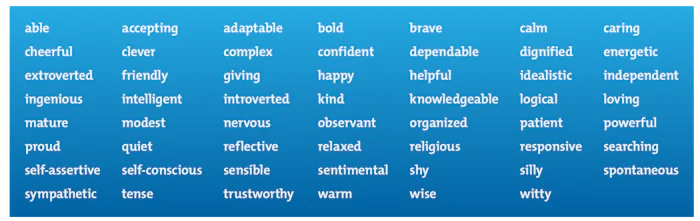
1. Identify Your Personal Characteristics – look at the list of characteristics in Figure 3, below. Then, choose the words that you think best describe you.
Figure 3: The 55 Adjectives of the Johari Window
Also, ask one or more of your colleagues to choose the adjectives that they feel best describe you.
Then, draw a Johari Window diagram, and fill in the quadrants as follows:
- Open Area: write the adjectives that both you and your colleagues chose.
- Hidden Area: write the adjectives that only you chose.
- Blind Area: write the adjectives that only your colleagues chose.
- Unknown Area: write the adjectives that were not chosen by any of you, but that you are prompted to consider as your self-awareness increases.
2. Define Your Goal – look at your completed Johari Window, and think about how you can increase your Open Area and reduce the other quadrants. For example, if you tend to be secretive, you may want to reduce the size of your Hidden Area. Or, if you're surprised by what your colleagues think about you, you might want to minimize your Blind Area.
3. Open Up and Ask For Feedback – to minimize your Hidden and Unknown areas, you need to reveal more about yourself. Self-disclosure is a give-and-take process of sharing information with other people. The more that you share your thoughts, feelings and opinions, the more your Open Area expands vertically and shrinks your Hidden Area, and the more people will likely trust you.
To reduce the size of your Blind or Unknown areas, you need to improve your self-awareness by seeking and accepting feedback.
This can be daunting, but finding out new things about yourself can also be empowering, and fun! When people provide feedback about you, and you are receptive to it, your Open Area expands horizontally and your Blind Area gets smaller.
If the size of your Unknown Area is a problem, look for ways to break out of your comfort zone. Taking on new challenges, testing your limits, and being open to new experiences can help you – and your colleagues – to learn more about your skills and abilities.
Frequently Asked Questions About the Johari Window
What Is the Johari Window?
The Johari Window is a model that helps people to better understand themselves and other people. It was created by psychologists Joseph Luft and Harrington Ingham in 1955 while they were researching group dynamics. Today, it is often used by organizations to develop people's soft skills, such as collaboration, empathy, and emotional intelligence.
What are the Four Quadrants of the Johari Window?
The four quadrants of the Johari Window are:
- Open Area – things that you and others know about you.
- Blind Area – things that you don't know about yourself, but others do.
- Hidden Area – things you know about yourself, but others don't.
- Unknown Area – things that neither you nor others know about yourself.
Can the Size of the Different Quadrants Change?
Yes! The size of each quadrant can change over time. For example, if you receive feedback about yourself, the size of the blind area may decrease because you've learned things about yourself you previously may have not been aware of. Similarly, if you reveal more about yourself to others, the size of the Hidden Area may decrease because you have become more comfortable sharing things with those around you.
What Is the Johari Window used for?
The Johari Window can benefit us, personally, because it enables us to become more aware of our own strengths, weaknesses, and behaviors. It can also help to improve communication within or between teams, as well as inclusion and equality. Teams can use it to help colleagues understand more about one another and use this information to communicate and collaborate more effectively together.
What Are the Limitations of the Johari Window?
The main criticism of the Johari Window is that it invites people to share quite personal information, which not everyone may be comfortable doing. The model relies on people being open and authentic, but most people, particularly in the workplace, will act and behave in a certain way to fit in. Another criticism is that it oversimplifies human behavior by splitting it into only four categories. Despite this, the model is still viewed as a popular tool for understanding interpersonal relationships and improving self-awareness.
Tips:
- You can use the Johari Window to help individual team members, or the team as a whole. Just substitute them for yourself, and involve their colleagues in the process.
- The results that you get from this exercise will differ depending on who else you involve. For example, if you work with multiple teams, one group might see you as dynamic, but the other might think you're distant.
- Feedback and disclosure can only flourish, and enable people to expand their Open Areas, in an environment with high levels of trust and a culture of honest, constructive communication. Some individuals, organizations and cultures have an open and accepting approach to feedback, but others don't. If you're using the Johari Window as a group activity, make sure that people give feedback constructively and sensitively.
- It's also important to make sure that no one feels pressured to share confidential information, or to disclose anything that makes them feel uncomfortable. Bear in mind that it may be wiser to facilitate feedback and disclosure on a safe, one-on-one basis, rather than in a group setting.
Key Points
- Joseph Luft and Harry Ingham developed the Johari Window in 1955. It's a simple but powerful visual tool for developing self-awareness, and for building trust and better workplace relationships.
- The Johari Window is divided into four key quadrants: the Open Area (things you and others know about yourself), the Blind Area (things that others know about you, but you are unaware of), the Hidden Area (things you know about yourself, but others don't), and the Unknown Area (things that unknown to you and to others).
- The Johari Window allows you to build a visual picture of your personality.
- You can also use it to develop greater self-awareness and team awareness of different people's characteristics, preferences, and abilities, as well as their strengths and weaknesses. This can improve team rapport, loyalty, and understanding.
- You can create your own Johari Window by following these three steps: First, identify your personal characteristics, then define your goal, and finally, open up and ask for feedback from others.
- The more you share your thoughts, feelings, and opinions, the more your Open Area expands vertically and shrinks your Hidden Area, and the more likely people will understand, accept and trust you.